

Payroll in Qatar: how to run it right every month
Payroll in Qatar is the monthly cycle of working out each worker's wage, taking off only the deductions the Labour Law allows, and paying the balance through the Wage Protection System. The deadline, the deduction caps and the exit rules are where companies get caught.
The month is closing, salaries are due, and the bank will not release a riyal until it has your salary file. Somewhere in that file sit an overtime claim, a loan repayment and a leaver who has to be paid out by tomorrow.
Payroll in Qatar is the monthly cycle of working out each worker's wage, taking off only the deductions the Labour Law allows, and paying the balance in Qatari riyals into a bank account in Qatar through the Wage Protection System (WPS). The calculation is the easy part. The deadline, the deduction caps and the exit rules are where companies get caught.
Key takeaways
What is payroll in Qatar?
Payroll in Qatar is a monthly obligation with three parts: pay the right amount, pay it the right way, and pay it on time. The Labour Law, Law No. 14 of 2004, sets the amount and the method. Ministerial Decision No. 4 of 2015 sets the timing and routes the payment through WPS.
The arithmetic is rarely the problem. Each rule sits in a different text, and each one bites at a different moment in the month.
Why payroll in Qatar goes wrong
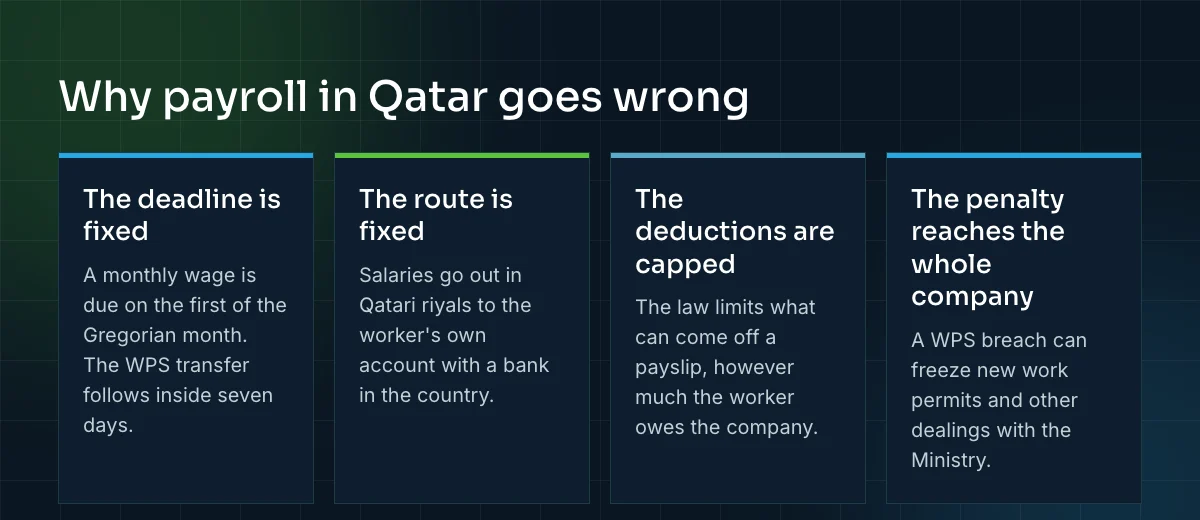
- The deadline is fixed. A monthly wage is due on the first of the Gregorian month, and the WPS transfer has to follow inside seven days.
- The route is fixed. Salaries go out in Qatari riyals to the worker's own account with a bank or financial institution in the country, and the employer is only cleared of the wage once that transfer is made.
- The deductions are capped. The law limits what can come off a payslip, however much the worker owes the company.
- The penalty reaches the whole company. A WPS breach can freeze new work permits and the company's other dealings with the Ministry, apart from contract attestation.
For a growing SME, the last point hurts most. A company that cannot obtain new work permits cannot hire, and the Ministry lifts the stop only once the employer shows that all overdue wages have gone out in full.
The Labour Law adds a criminal penalty on top. A breach of Article 66, the article on how wages are paid, is punishable by imprisonment of up to one year, a fine of QAR 2,000 to QAR 10,000, or either one.
So the risk in payroll sits in the calendar and the caps, and a correct calculation paid late is still a breach.
What a payroll month looks like
- Overtime sheets arrive late, so the salary file reaches the bank in the final days before the deadline.
- Loan and advance repayments sit in a separate spreadsheet that nobody checks against the legal cap.
- Leave balances live in the HR file, and payroll learns about unused days only when someone resigns.
- Gratuity is paid out of that month's cash when a worker leaves, because nothing was set aside for it.
- A Qatari employee joins, and the social insurance contribution is missed until the fund asks for it.
- The salary cost in the books does not match the total the bank actually transferred.
In most SMEs, payroll lives with one person. Sometimes it is the accountant, sometimes the office manager, sometimes the owner on the last weekend of the month. The work gets done, and the gaps only show when something unusual happens, as in the month described above.
None of these breaks the law on the day it happens. Each one becomes a problem at an edge: the month the file goes late, the worker whose deductions pass half the salary, the leaver who has to be paid by the next working day.
The owner rarely sees any of it. Salaries go out, staff are paid, and the exposure builds in the background until a resignation, a dispute or a Ministry stop brings it to the surface at once.
If two or more of those lines describe your company, the fix is to put the month in a fixed order and to keep the balances that payroll depends on current every month.
Payroll in Qatar, step by step
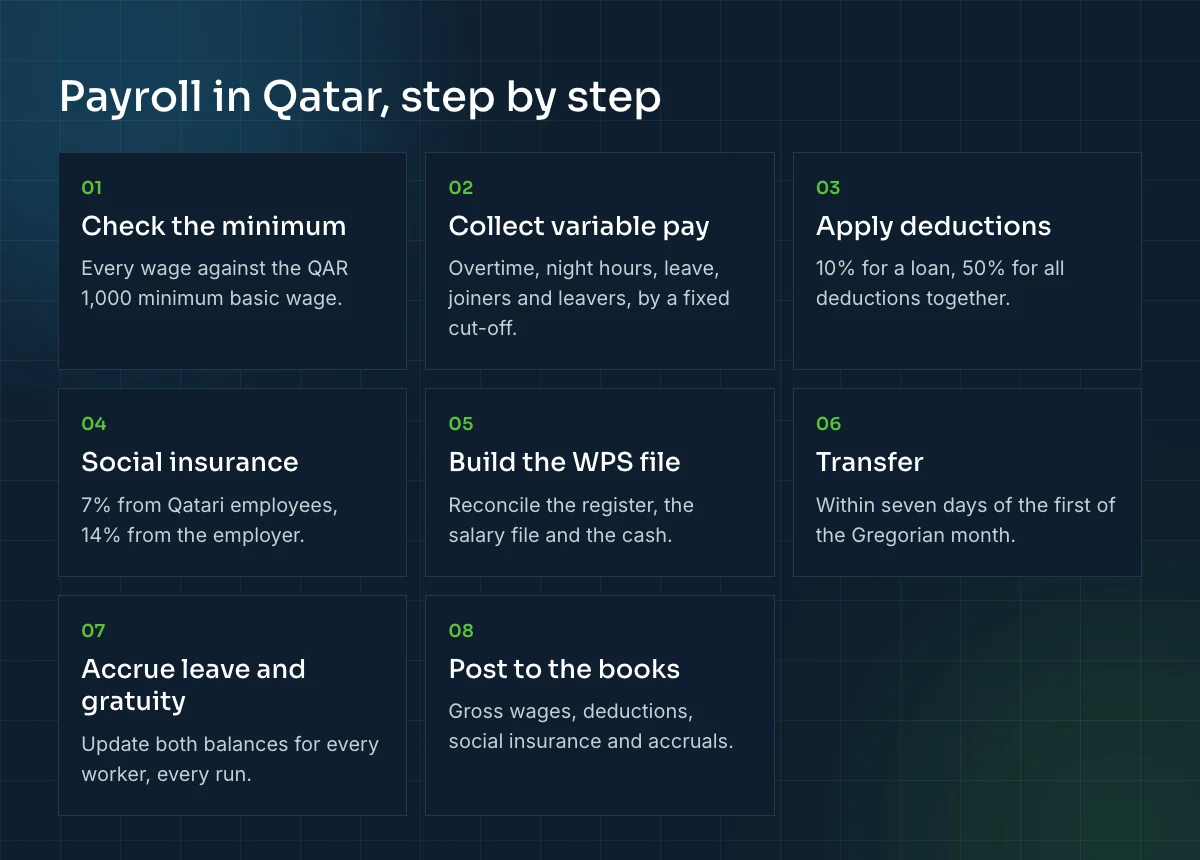
- Check every wage against the minimum. Ministerial Decision No. 25 of 2020 sets the minimum basic wage at QAR 1,000 a month. Where the employer does not provide suitable housing or food, the minimum allowances are QAR 500 a month for housing and QAR 300 a month for food. Confirm those figures are still current whenever you set a new salary, and check every contract on the payroll against them once a year.
- Collect the month's variable pay. Variable pay is where late inputs come from. Fix a cut-off date for each item and hold it every month: overtime hours approved by the line manager, hours worked between 9 pm and 3 am, annual leave taken in the month, new joiners with their start date and bank account details, and leavers with their last working day. The Labour Law caps actual working hours, overtime included, at ten a day, unless the work is needed to prevent serious loss or a dangerous accident. Overtime is paid at the basic hourly wage plus at least 25%. Night work between 9 pm and 3 am is paid at the basic wage plus at least 50%, except for shift workers.
- Apply deductions inside the caps. Deductions are the step most likely to cross a legal line without anyone noticing. Three limits apply, set out in the box below. No income tax comes off the payslip. The Income Tax Law, Law No. 24 of 2018, does not apply to salaries, wages and allowances.
- Deduct social insurance for Qatari employees. The Social Insurance Law, Law No. 1 of 2022, covers Qatari nationals, including Qatari workers in the private sector who fall under the Labour Law. Contributions total 21% of the contribution salary, with that salary capped at QAR 100,000. 7% is deducted from the employee's salary and 14% is paid by the employer, and both reach the fund by the fifth day of the following month. Late contributions attract a delay fine of 2% a month on the amount outstanding until it is paid. Run this step in the same cycle as the salary itself, so a new Qatari hire is never missed for a month.
- Build and check the WPS salary file. The salary file is what your bank processes through WPS. Ask your bank for the format it accepts, because Decision No. 4 of 2015 does not set the file out field by field. Our guide to the Wage Protection System in Qatar covers the rules the file has to meet. Before the file goes, reconcile three totals: the payroll register, the salary file, and the cash in the account that will fund it. A mismatch found now costs an hour. A mismatch found after the transfer costs a correction run and, possibly, a late wage.
- Transfer inside the seven days. A monthly wage falls due on the first day of each Gregorian month. Workers paid other than monthly are due their wage on the first day of every two weeks. Under Decision No. 4 of 2015, the employer then has seven days to put the money in the worker's account through WPS. If your company used a different pay date in the past, confirm with the Ministry how the first-of-month due date applies to you. We found no Ministry guidance on that transition.
- Accrue leave and gratuity. Every payroll run should update two balances for every worker. For annual leave, after one full year of continuous service, a worker earns at least three weeks of paid leave a year, rising to at least four weeks from five years of service, with part years in proportion. For end of service gratuity, after one year of service, the employer owes at least three weeks' wage for each year worked, with part years in proportion. Leave pay and gratuity are both calculated on the basic wage on the date they fall due. For piece-rate workers, the base is the average wage of the previous three months. Our guide to end of service gratuity in Qatar sets out the calculation in full.
- Post payroll to the books. Close the month by posting the payroll journal: gross wages, deductions, social insurance owed, and the change in the leave and gratuity accruals. Mavensmark posts payroll to the books every month as part of our accounting and bookkeeping work, so the salary cost in the accounts matches what the bank transferred.
The order above is the one we run payroll in. Each step feeds the next, and the WPS deadline sits at step six, so the first five have to finish in the first days of the month.
The step people skip
The step people skip is the final settlement, and it is skipped because it only happens when someone leaves. By then the deadline is already running.
The final settlement, rule by rule
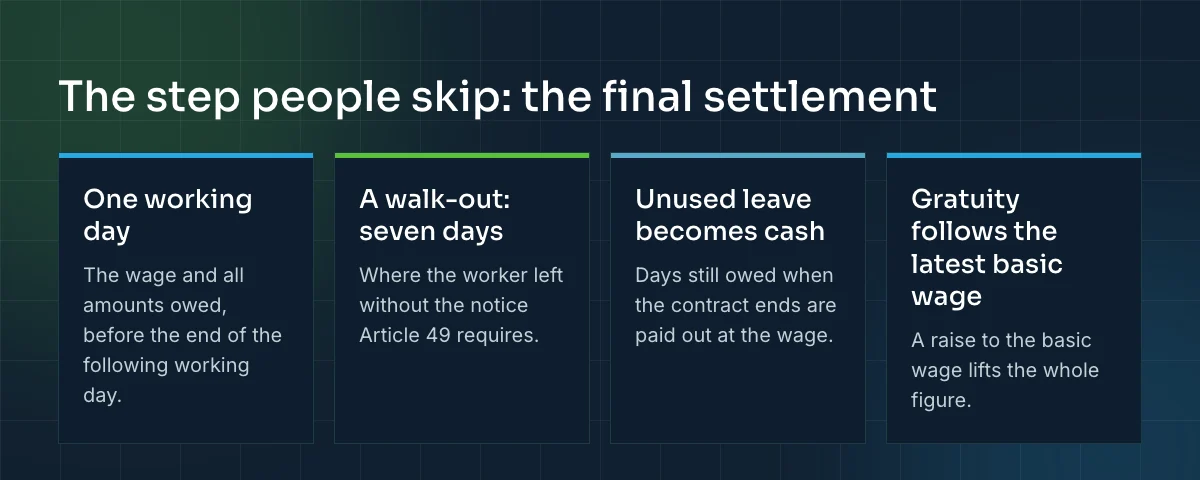
- The deadline is one working day. When a contract ends for any reason, the employer must pay the wage and all amounts owed before the end of the following working day.
- A walk-out moves the deadline to seven days. Where the worker left without the notice Article 49 requires, the employer has seven days from the date the worker left.
- Unused leave becomes cash. A worker cannot give up annual leave, and days still owed when the contract ends are paid out at the wage.
- Gratuity follows the latest basic wage. Gratuity is calculated on the basic wage on the day it falls due, so a raise to the basic wage lifts the whole figure.
One working day is too short to reconstruct a leave balance, check a loan balance and calculate gratuity from scratch. The move is to keep a running settlement for every worker, updated with every payroll run. It holds the leave days owed, the gratuity accrued, any loan balance outstanding, and the basic wage it all rests on.
With that figure current, a resignation becomes a payment you have already worked out. Finance can also see the total exit liability across the workforce in one number, which is worth knowing before you plan cash for the quarter.
The penalty for a late final settlement under Article 67 is not settled in the sources we checked, so we would not plan on any particular figure. Pay on time and the question does not arise.
Mavensmark handles hiring, payroll, employment contracts and labour law compliance in Qatar through our HR and manpower service, and the running settlement is part of the monthly payroll we prepare. If a resignation has just landed and the settlement is due tomorrow, book a consultation.
When the problem sits outside payroll
Sometimes payroll is late for reasons a better process cannot fix.
If the account that funds the salary file is short on the first of the month, the problem is cash flow. WPS records when the money moved, and a perfect salary file paid after the seven days is still a late wage. Fix the cash plan first.
If the dispute is over what a worker is owed, the problem often sits in the contract. Leave pay and gratuity both run on the basic wage, so the split between basic wage and allowances written into the contract decides those figures long before payroll calculates them.
If you have a handful of staff on fixed salaries, and none of them works overtime, carries a loan or is a Qatari national, a spreadsheet and your bank's salary file can be enough. Write the steps above into a checklist and run it the same way each month.
The decision between in-house and outsourced payroll usually comes with growth: more joiners, more overtime, a first Qatari hire. If you are comparing WPS payroll in Qatar software packages at that point, check that the package holds the deduction caps, leave balances and gratuity accrual, and test its salary file with your bank before the first live month.
If you would rather hand your payroll in Qatar to people who run it every month, book a consultation.
Frequently asked questions
When must salaries be paid in Qatar?
How much can an employer deduct from a salary in Qatar?
Is there income tax on salaries in Qatar?
Who pays social insurance in Qatar?
When must a final settlement be paid?
Sources
Related services
HR Consultancy & Manpower
Recruitment, payroll and HR compliance that gives you the right people without the overhead.
Learn more →Accounting & Bookkeeping
Accurate, standards-compliant books, so you always have reliable numbers for decisions and audits.
Learn more →PRO Services
Government liaison and document clearing that keeps your licences, visas and permits current.
Learn more →