

The Wage Protection System in Qatar: what employers must do
Wages through a Qatari bank within seven days, plus a monthly file. The rule is simple; the penalty is charged per worker and per instance, and there are two of them.
The Wage Protection System in Qatar is the mechanism that makes wage payment visible to the state. Every employer covered by the Labour Law must pay wages through a financial institution inside Qatar, within seven days of the due date, and send the bank a file each month setting out exactly what each worker was paid. It has been mandatory since 2 November 2015.
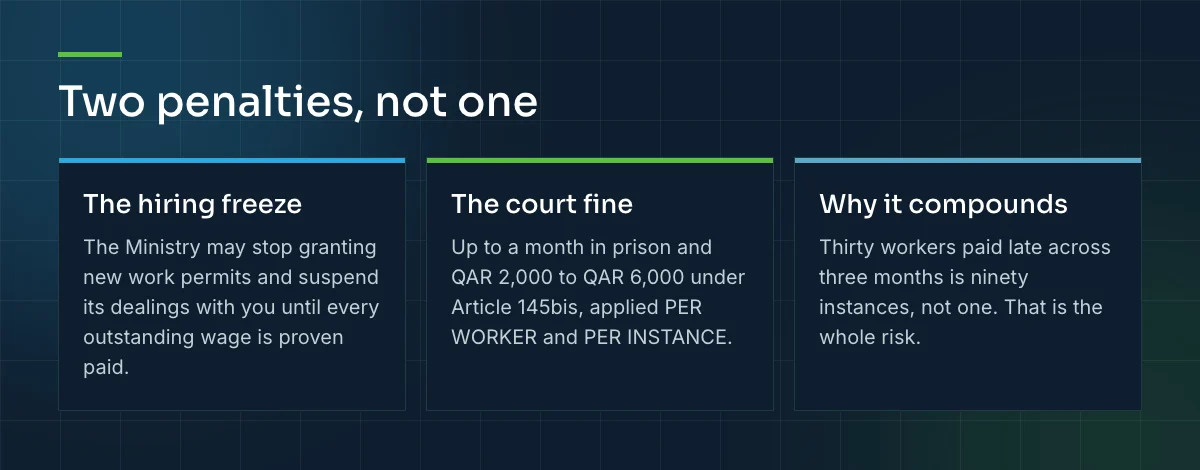
That is the whole obligation. What catches employers is not the rule, it is the arithmetic behind the penalty, and the fact that there are two separate consequences rather than one. The fine is charged per worker and per instance. A company of thirty people that runs three months late is not exposed to one fine of a few thousand riyals.
This is written for the employer. If you are an employee looking for what to do about unpaid wages, the route is a complaint to the Ministry, not this page.
What the Wage Protection System actually requires
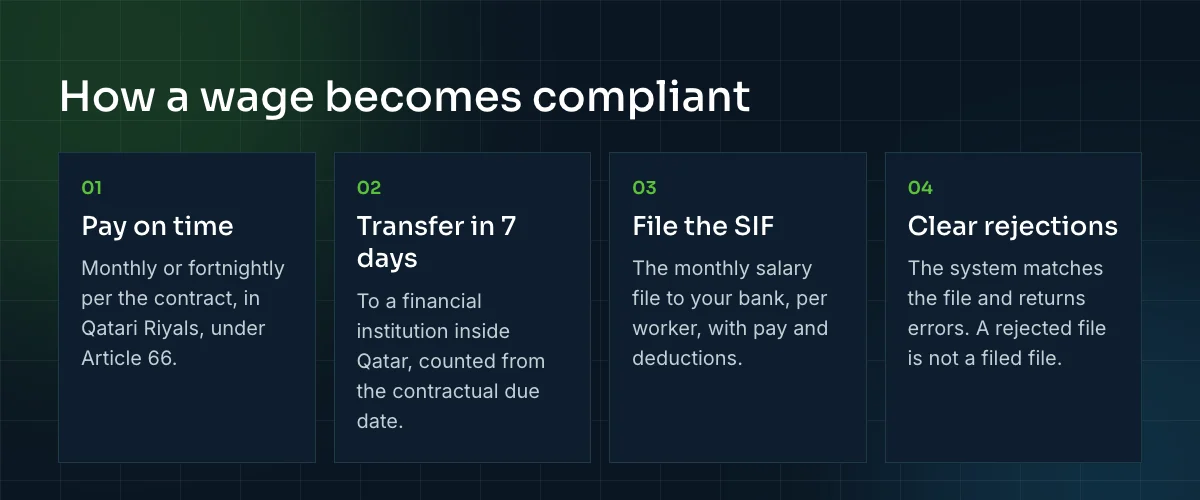
- Wages are paid monthly or fortnightly, according to the contract, under Article 66 of the Labour Law as amended by Law No. 1 of 2015
- Wages are paid in Qatari Riyals
- Wages are transferred to a financial institution inside Qatar within seven days of the due date, through the WPS, under Article 2 of Ministerial Decision No. 4 of 2015
- A Salary Information File goes to your bank every month
Four obligations, and they come from two instruments.
Who is covered, and who sits outside it
| Excluded group | Note |
|---|---|
| Government and the petroleum sector | Ministries, public authorities and corporations, and companies in the petroleum sector |
| Armed forces, police, workers at sea | Employment regulated separately |
| Casual workers | Not engaged on a continuing basis |
| Domestic employment | Drivers, nurses, cooks, gardeners. Covered instead by Law No. 15 of 2017 |
| The employer's own family | Spouse, ascendants and descendants living with and wholly dependent on them |
| Agriculture and livestock | With carve-outs for processing, marketing and machinery roles |
The WPS system in Qatar follows the Labour Law. Anyone excluded from the Qatar Labour Law No 14 of 2004 is excluded from the WPS, and Article 3 of that law sets out the list.
The domestic staff exclusion catches people out
Your driver and your cook at home are not on the WPS. They sit under the Domestic Workers Law, Law No. 15 of 2017, which requires regular monthly payment. The obligation to pay them properly did not disappear; it simply is not policed through this system, so employers who assume the bank file covers their whole household are wrong on both counts.
The Salary Information File, and what your bank needs
| Field | What it must show |
|---|---|
| Identity | Worker name, Qatar ID number and visa number |
| Bank details | Bank name and account number |
| Period | Frequency of payment and the number of working days in the wage period |
| Pay | Net salary, basic salary under the contract, and any extra hours worked |
| Other remuneration | Transport, housing, food, bonuses, back-pay and advance vacation pay |
| Deductions | Loan repayments, charges for damages, and fines imposed under the law |
Each month you send the bank a Salary Information File, an electronic file in two parts: a header carrying the entity's own data, and the salary records themselves.
Why the file is a payroll problem, not a banking one
That list is the reason WPS filing sits with payroll rather than with your bank relationship. The file is only as good as your underlying records, and the fields it demands are exactly the ones that get approximated when payroll is run off a spreadsheet: what counts as basic versus allowance, how many days were actually worked, what a deduction was for.
Your file goes to the bank. The bank enters the data into the WPS. The system runs an electronic match against the structure it expects and returns errors where the file does not conform.
Rejections are the most common way WPS in Qatar goes wrong for an employer who is otherwise paying everyone correctly and on time. They are usually structural rather than financial: a mismatched Qatar ID, an account number that does not belong to the named worker, a field the format does not accept. That matters because a rejected file is not a filed file. If the rejection lands on day six and nobody notices until day nine, you are late, and lateness is measured against the seven days rather than against your intent.
The penalties, and why they are worse than the headline
Almost every guide quotes one fine. There are two separate tracks, and they are not alternatives.
The first is administrative, under Article 4 of Ministerial Decision No. 4 of 2015. The Minister or a delegate may discontinue granting any new work permits, and suspend all dealings with the Ministry, with the certification of employment contracts excepted. The suspension is lifted by a decision of the Minister once the employer proves that all outstanding wages have been transferred.
For a growing company this is by far the more expensive one. It does not fine you, it freezes you. You cannot bring anyone new into the country while it stands, which stops project mobilisation and hiring dead, and it lifts on the Ministry's timetable rather than yours.
The second is criminal, under Article 145bis of the Labour Law, added by Law No. 1 of 2015: a sentence of not more than one month in prison and a fine of not less than QAR 2,000 and not more than QAR 6,000, or either. These penalties apply per worker and per instance of a violation. The fines are ordered by a court, not by the Ministry, which does not have the power to collect them and refers cases to the police or the public prosecution service.
The minimum wage sits alongside this
| Component | Amount |
|---|---|
| Basic wage | QAR 1,000 |
| Accommodation allowance | QAR 500, or accommodation provided |
| Food allowance | QAR 300, or food provided |
Since March 2021, Law No. 17 of 2020 has set a universal, non-discriminatory minimum wage covering all private sector workers including domestic workers, with the allowances payable in kind or in cash depending on what the employer provides.
Where the two rules meet
They meet in your file. The Wage Protection System in Qatar is what makes minimum wage compliance visible, because the amounts you declare per worker are the amounts the state sees. Paying the right number but declaring it wrongly creates a problem you did not actually have.
What we do
Mavensmark runs payroll and WPS filing for companies in Qatar as part of HR and manpower services: the monthly file, the reconciliation to your accounts, and the follow-up when a bank rejects a record. Because the same team keeps your books, the wage figures in the file agree with the wage figures in your accounts, which is where a surprising number of inspections start.
If you are setting up and have not hired yet, fold this into company setup rather than discovering it with your first employee. The obligation begins with the first hire, not with your first inspection.
Frequently asked questions
What is the Wage Protection System in Qatar?
What does the Qatar labor law on delayed salary say?
What actually happens if we pay late?
Does WPS cover our driver or our cook at home?
We are in a free zone or the QFC. Does this apply to us?
Related services
HR Consultancy & Manpower
Recruitment, payroll and HR compliance that gives you the right people without the overhead.
Learn more →Accounting & Bookkeeping
Accurate, standards-compliant books, so you always have reliable numbers for decisions and audits.
Learn more →Company Setup & Formation
Structure and launch your company in Qatar with the right legal framework from day one.
Learn more →