

End of service gratuity in Qatar: an employer's guide
Three weeks' basic wage per year after one year of service, on the last basic wage. The rate does not change at five years, whatever most guides tell you.
End of service gratuity in Qatar is set by Article 54 of the Labour Law. A worker who completes one year or more of employment is owed, at minimum, three weeks' wage for every year of service, pro-rated for part years, calculated on the last basic wage. It is due in addition to everything else owed at the end of service, and the employer may deduct from it whatever the worker owes them.
That is the entire rule. Two things go wrong around it, and neither is about the arithmetic. The first is that gratuity is a liability that builds quietly and is usually only noticed when someone resigns. The second is a widely repeated myth about what happens at five years.
What Article 54 actually requires
- The entitlement starts once the worker has completed one year or more of employment
- The minimum is not less than three weeks' wage for every year of employment
- Fractions of a year are paid in proportion to the duration of employment
- The last basic wage is the base for the calculation
- It is paid in addition to any other sums owed on expiry of service
- The employer may deduct from it any amount the worker owes them
Two details in that list carry more weight than they look. "Not less than" means three weeks is a floor, not a formula: a contract or policy can promise more, and once promised it is enforceable. And service counts as continuous if it ended for a reason other than those in Article 61 and the worker returns within two months, so a short break does not reset the clock.
Basic wage is not the same as wage
| Term | What it covers | Used for gratuity |
|---|---|---|
| Basic wage | The rate of payment for the work done, including periodic increment. Excludes allowances and bonuses. | Yes, the last basic wage is the calculation base |
| Wage | Basic wage plus all increments, allowances and bonuses paid in return for work. | No, despite the minimum being stated in weeks of wage |
The gratuity law in Qatar draws a distinction that decides the size of every payment, and the definitions are in Article 1 of the same law. Article 54 sets the minimum in weeks of wage but then states expressly that the last basic wage is the base for the calculation.
Why the split in your contracts matters
In practice that means the split in your employment contracts between basic and allowances directly determines what you owe at the end. This is not an invitation to shrink the basic and inflate the allowances. It is a warning that if your contracts were drafted without attention to the split, or if allowances have been folded into basic informally over the years through payroll practice, your exposure is not what your contract template says it is.
The five year question, answered honestly
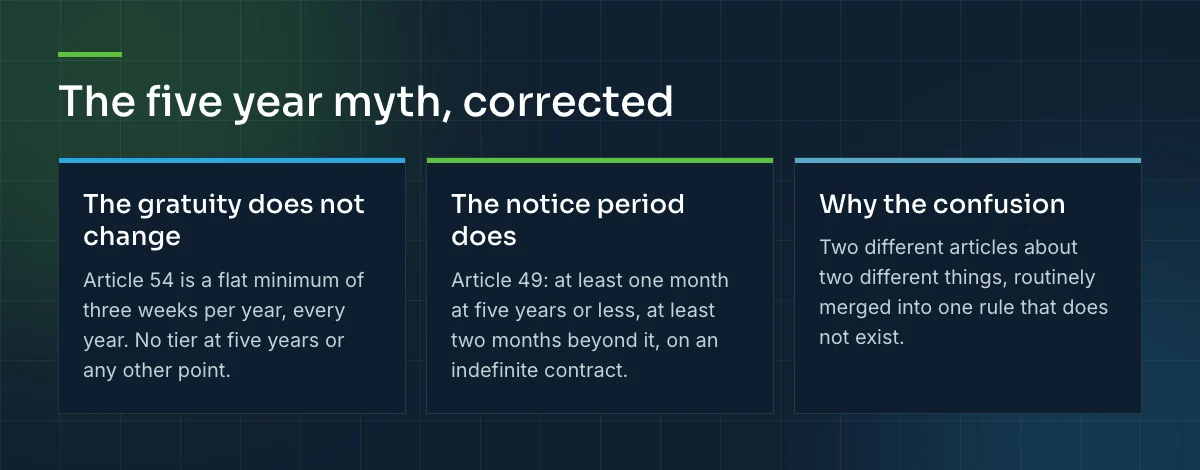
This is the most searched thing about gratuity in Qatar and the most misreported. The short version: nothing about the gratuity rate changes at five years.
Article 54 sets a flat minimum of three weeks per year for every year of employment. There is no tier, no step-up and no multiplier at five years, ten years or any other milestone. A worker with seven years is owed seven times the annual figure, not a higher rate for the later years.
What does change at five years is the notice period, and that is Article 49, a different article about a different thing. On an indefinite contract, a monthly paid worker with five years or less of service is entitled to at least one month's notice; more than five years and it is at least two months. Terminating without observing the period obliges the terminating party to compensate the other for the wage covering it.
So both things are true: five years matters, and it does not change the gratuity. Guides that merge the two are describing a rule that does not exist.
Gratuity calculation in Qatar, step by step
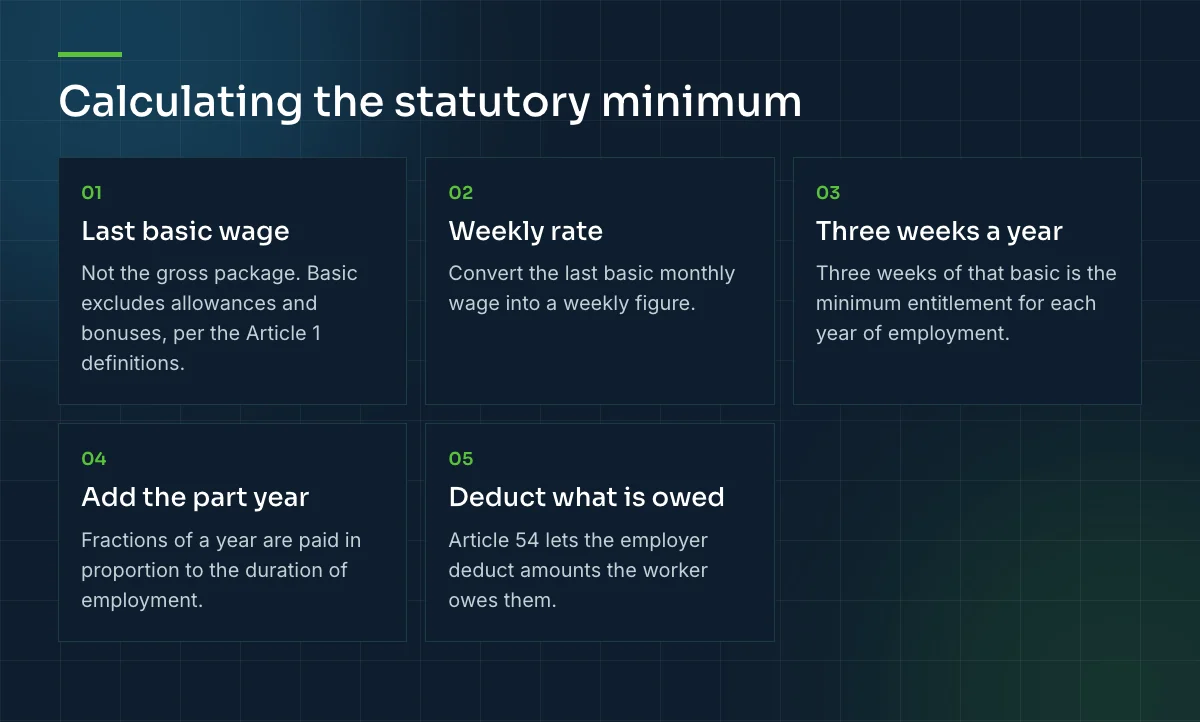
Take the last basic wage, not the gross package. Convert it to a weekly figure. Three weeks of that is the annual entitlement. Multiply by completed years, add the pro-rated fraction for the part year, then deduct anything the worker owes you.
Worked through on an illustrative figure: a worker on a last basic wage of QAR 6,000 a month has a weekly basic of roughly QAR 1,385. Three weeks is about QAR 4,154 for each year of service. After four years and six months, the entitlement is four full years plus half of a fifth, so roughly QAR 20,769 before any deduction.
Use your own numbers rather than that example, and note that if your contracts or your policy promise more than the statutory three weeks, the higher figure is what you owe.
When end of service gratuity in Qatar can be withheld
Article 61 sets out ten instances in which the employer may dismiss a worker without notice and without payment of end of service gratuity. They include assuming a false identity or submitting false documents; committing an act causing gross financial loss to the employer, provided the employer notifies the Department within twenty four hours of becoming aware of it; repeatedly violating written safety instructions after written warning; repeatedly failing to carry out essential duties after written warning; disclosing the secrets of the establishment; being drunk or under the influence of a drug during working hours; assaulting the employer, manager or a supervisor; repeatedly assaulting colleagues after written warning; absence without legitimate cause for more than seven consecutive days or fifteen days in a year; and a final sentence for a crime involving immorality or dishonesty.
The procedural half is where employers lose. Article 62 requires that a worker is not accused of a violation more than fifteen days after the employer became aware of it, except where the violation is a criminal offence; that the penalty relates directly to the work; that the worker is informed of the accusation and inquired into in writing; and that only one penalty is imposed for a single violation.
It is a liability, not a year-end surprise
End of service benefits in Qatar accrue with every month an employee works. The obligation exists whether or not it has been paid, and it should sit in your accounts as a provision that grows, not appear as a cost in the month somebody happens to leave.
Companies that do not accrue it discover the problem in one of three ways: a cluster of resignations produces a cash demand nobody budgeted for; an auditor raises it and the prior year figures have to be restated; or a buyer's due diligence finds an unrecorded liability and prices it into the deal. All three are avoidable with a schedule that is updated monthly and reconciled to payroll.
Because Mavensmark keeps the books and prepares the file for audit, the gratuity provision in your accounts is built from the same payroll data that produces the final settlement, which is where the two usually diverge.
What we do
We run the end of service gratuity in Qatar as a live schedule rather than a year-end exercise, as part of HR and payroll: the accrual per employee, the reconciliation to your accounts, the calculation at exit and the documentation behind any decision to withhold. If you are hiring your first employees, this belongs in the setup conversation alongside WPS registration, not two years later when the first person resigns.
Frequently asked questions
What does the Qatar labour law gratuity after 5 years actually change?
How is gratuity calculated in Qatar?
Does an employee who resigns still get gratuity?
Can we withhold gratuity for poor performance or a handover dispute?
Should gratuity appear in our financial statements before anyone leaves?
Related services
HR Consultancy & Manpower
Recruitment, payroll and HR compliance that gives you the right people without the overhead.
Learn more →Accounting & Bookkeeping
Accurate, standards-compliant books, so you always have reliable numbers for decisions and audits.
Learn more →Internal & External Audit
Internal, external and forensic audits that surface risk, strengthen controls and build confidence.
Learn more →