

Qatar company registry: how to check a company before you extend credit
A Qatar company registry is the official record of who may trade in Qatar and what they do. Pull the record from the register itself, read it for its gaps, and ignore anything the counterparty sends you as proof.
A new customer wants sixty days on your invoice, and all you hold is a purchase order, a phone number and a logo on a letterhead. Before the goods leave, you want to know the company is real and that you are contracting with it.
A Qatar company registry is the official record of who may trade in Qatar and what they do. For most companies that record is the commercial register, which a department of the Ministry of Commerce and Industry (MOCI) keeps under Law No. 25 of 2005. Pull the record from the register itself, read it for its gaps, and ignore anything the counterparty sends you as proof.
Why a company search is harder than it looks
Most people search a company name, find a listing, and stop. A listing shows a name appears somewhere, which is short of a registered, active company that is the party on your contract.
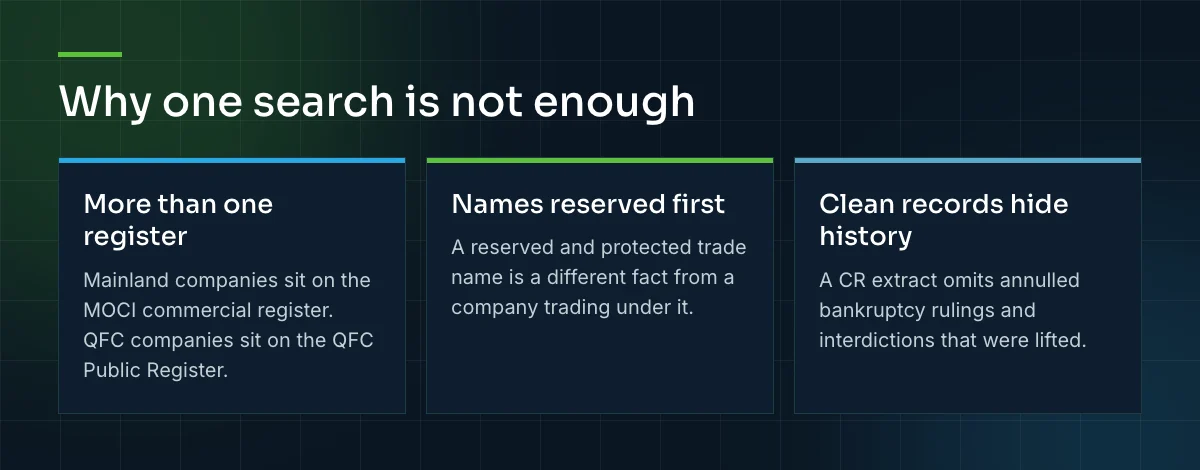
Three things make the check harder than one search.
There is more than one register. Mainland companies sit on the MOCI commercial register, and companies licensed in the Qatar Financial Centre sit on the QFC Public Register.
Names are reserved before they trade. The MOCI Trade Names Search shows names that are reserved and protected, which is a different fact from a company trading under that name.
Clean records can hide history. Under the law, a CR extract omits bankruptcy rulings that were annulled or where the trader's reputation was restored, and interdictions that were lifted.
The economic zones are also changing hands. MOCI has launched Dar Al Sharikat, which now holds the public register for the QFC, the Qatar Free Zones Authority, Qatar Science and Technology Park and Media City Qatar. We could not confirm where those registers will be searched after the move, so check the current location each time.
What a registry check looks like
A buyer sends a purchase order on letterhead, follows up by phone, and asks you to ship this week. The company has a directory profile with a website and a Doha address.
Each of those items can be produced by someone who is not a registered company. Business directories in Qatar are often filled in by the member companies themselves, so the profile says what the company chose to say about itself. One chamber platform states outright that it does not check whether the companies it lists exist, and it sends readers to MOCI for Qatari companies.
The same platform reports that Qatari firms have paid fake companies that responded to purchase orders. Its advice is to stop treating a purchase order or a phone call as verification.
If your customer file holds only documents the customer gave you, you have checked its paperwork, and the Qatar company registry is the one source the counterparty does not write.
Qatar company registry, step by step
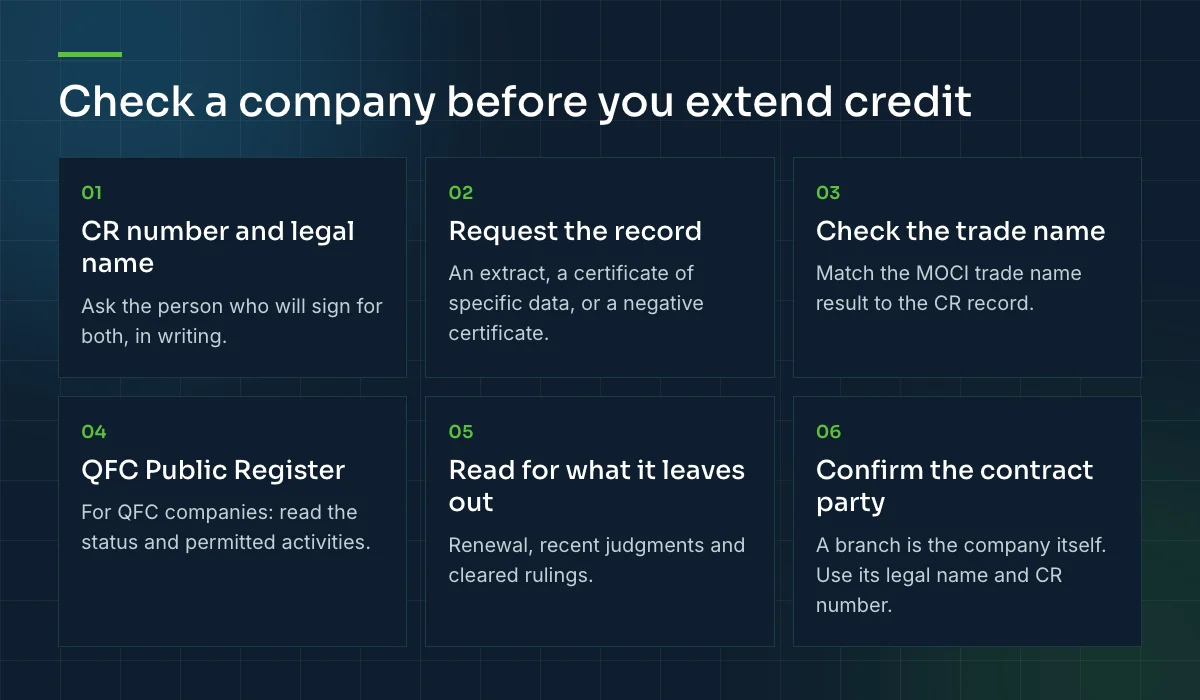
- Get the CR number and the exact legal name. Ask the person who will sign for the commercial registration (CR) number and legal name in writing. A letterhead trading name is too thin to search on. If the counterparty will not give you a CR number before you extend credit, treat that as your answer.
- Request the record from MOCI. Law No. 25 of 2005 gives any interested party the right to obtain three documents from the department that keeps the register: an extracted copy of the company's record, a certificate of specific data from the record, and a negative certificate, stating that there is no registration. The negative certificate is the document that tells you a name you were given is not registered at all.
- Check the trade name against the registration. Search the name on the MOCI Trade Names Search. A result tells you the name is reserved and protected by law. It does not tell you a company is trading under it, so match the trade name to the CR record from step 2 before you rely on it.
- Use the QFC Public Register for QFC companies. If the counterparty says it is licensed in the QFC, search the QFC Public Register. Anyone can see a QFC company's details there, including the activities it is permitted to carry out. The register covers LLCs, LLPs and branches that are registered or were registered in the past. A listing alone does not prove the company is active, so read its status, and check that its permitted activities cover the deal you are about to do.
- Read the record for what it leaves out. Three gaps sit inside an extract that looks clean. Renewal: a CR registration runs for a fixed period, and MOCI may delete it when no renewal is filed ninety days after the holder was notified. Recent judgments: court registries have thirty days to send bankruptcy, liquidation and dissolution judgments to the Ministry for annotation, so a recent judgment may not appear yet. Cleared rulings: annulled bankruptcies and lifted interdictions are left out of the extract.
- Confirm the party on your contract. Under the law, a branch is registered under the company's own CR number and is not a separate legal person. A branch you trade with is the company itself, so put the company's legal name and CR number on the contract and the invoice.
Run the six steps above before you agree credit terms, and keep what each one produces on the customer file.
The MOCI app now issues CR certificates and extracts instantly. Reports say four certificates are free and selected certificates cost QAR 50, without listing which is which. Mavensmark could not confirm whether a third party, as opposed to the CR holder, can request each certificate through the app or through Hukoomi, or what the official CR inquiry by number shows to an outside party. Confirm both with MOCI for your case.
The step people skip
Most checks stop once the record comes back. The step that protects you later is tying that record to every document the deal produces.
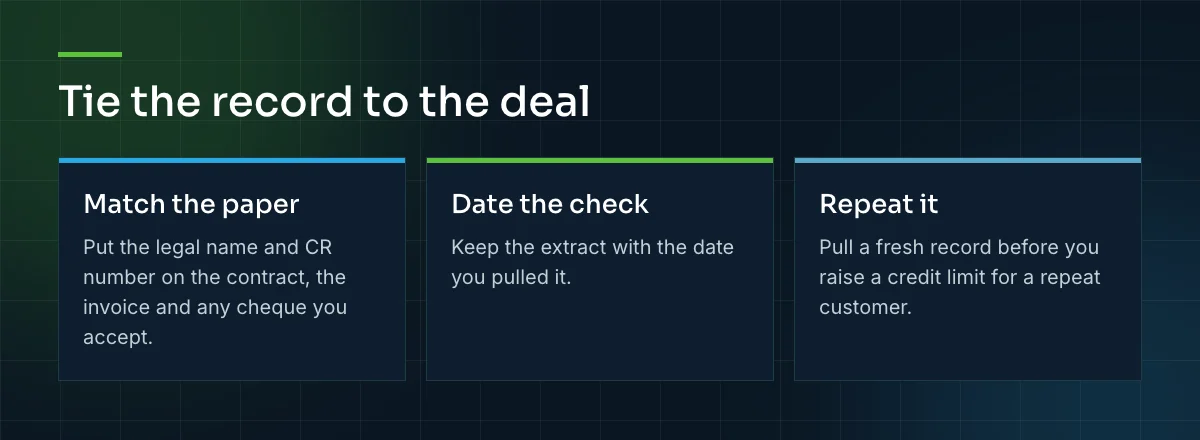
Match the paper to the record. Put the legal name and CR number from the extract on the contract, the invoice and any cheque you accept, so the debtor named in a dispute is the registered company.
Date the check. Keep the extract with the date you pulled it. If the account goes bad, you can show what the register said when you agreed the terms.
Repeat it for repeat customers. A registration can lapse or be deleted after you first checked it, so pull a fresh record before you raise a credit limit.
If a cheque from that customer is later returned, our guide to the bounced cheque law in Qatar sets out what you can do next. A file built around the registered company is also the file a debt recovery claim starts from.
When a valid registration is not enough
A clean record answers one question: does this company legally exist and trade here. It says nothing about whether the company can pay you.
For a large order, a long credit period or an acquisition, the question is the counterparty's financial position. That needs its accounts, its liabilities and an independent view of what the business is worth. Our company valuation and due diligence work covers that ground.
If the invoice is already past due, the register check is done and the next step is recovery.
If you are about to extend credit to a company you have not checked, or a checked one has stopped paying, book a consultation with Mavensmark.
Frequently asked questions
What is a Qatar company registry?
Can anyone get a CR extract in Qatar?
Does a trade name search prove a company exists?
Is a branch a separate company in Qatar?
How much does a CR certificate cost?
Sources
- Law No. 25 of 2005 regarding the Commercial Register, Al Meezan
- Trade Names Search, Ministry of Commerce and Industry
- QFC Public Register, Qatar Financial Centre
- Minister of Commerce and Industry launches Dar Al Sharikat, Qatar News Agency
- qatarcid.com 2021, Qatar Chamber
- International B2B Platform, Qatar Chamber
- Qatar MOCI app adds instant certificate issuance and establishment renewal services, Qatar Living