
Bounced cheque law in Qatar: what the holder can do
A returned cheque in Qatar is a civil debt and, where the drawer acted maliciously, a criminal offence. The criminal court can order your money back, on request.
Your customer handed over a cheque, you banked it, and it has come back unpaid. The money is still owed, and you have more to work with than most people in that position realise.
A bounced cheque in Qatar is a cheque the paying bank has returned because the account behind it did not hold enough money to meet it. Bounced cheque law in Qatar treats that as a civil debt and, where the person who wrote it acted maliciously, as a criminal offence as well. The second of those is usually what gets a creditor paid.
What bounced cheque law in Qatar actually covers
- Six months to present a cheque drawn and payable in Qatar
- Eight months where the cheque was drawn outside Qatar
- A post-dated cheque cannot be paid before the date on it
- The bank carries the loss if it pays a post-dated cheque early
- The drawer cannot cancel a cheque because a dispute has arisen
Three things catch businesses out before the question of recovery even arises, and the list above is the short version of them. The first is time. A cheque written and payable here has to be presented to a bank within six months of the date written on its face, and a cheque drawn outside Qatar but payable here has eight months. Miss it and you are arguing about a debt rather than enforcing an instrument.
The second is the post-dated cheque, which is how a great deal of business credit is extended in Doha. A cheque is payable on sight, and any wording on it saying otherwise counts for nothing. Where a later date is written on the cheque, the bank cannot pay it before that date arrives, and a bank that pays early is liable for the damage it causes.
The third is the one that surprises people most. The person who signed the cheque cannot simply telephone the bank and cancel it. An objection from the drawer is only accepted where the cheque has been lost, or where the holder is bankrupt or under interdiction. A customer who has changed their mind about paying you has no route to stop the cheque.
What the bank must do when the funds fall short
Most guidance on this subject predates that change, and repeats a rule that is no longer the rule. Where the account holds less than the cheque is written for, the bank now has to pay you what is actually there unless you say no.
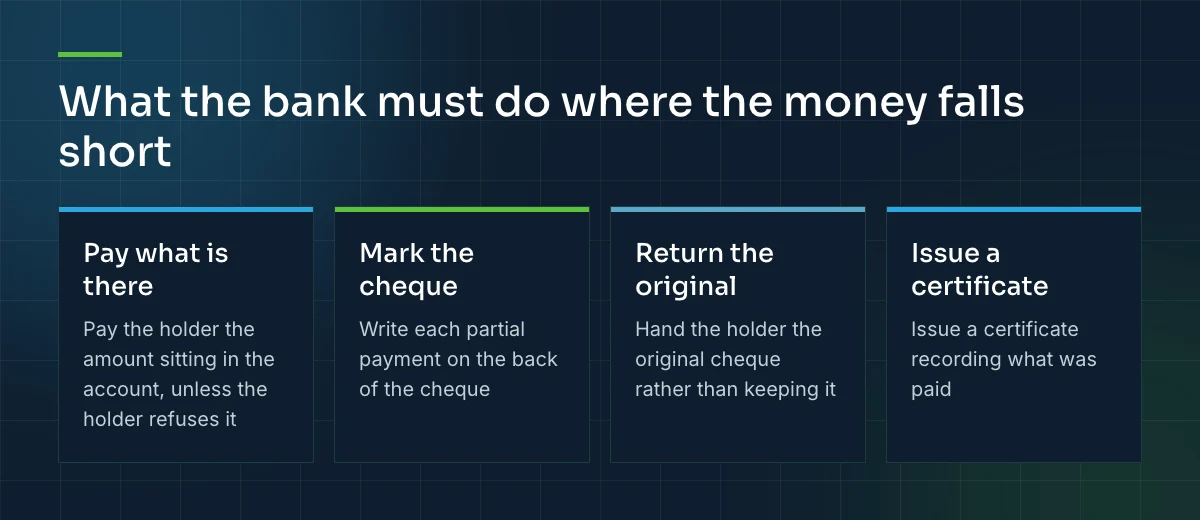
The amendment came into force on 6 April 2024. The practical effect is that a cheque for QAR 300,000 drawn on an account holding QAR 40,000 is no longer simply returned: the bank pays out the QAR 40,000, writes the payment on the reverse of the cheque, and hands you the cheque itself along with a certificate.
The bank's four obligations on a short cheque
- Pay the holder the amount sitting in the account, unless the holder refuses it
- Write each partial payment on the back of the cheque
- Hand the holder the original cheque rather than keeping it
- Issue a certificate recording what was paid
Your claim for the balance rests on the marked original and that certificate, so neither should leave your hands. A holder who would rather keep the cheque intact can decline the partial payment, though the reason to do that is tactical rather than legal, and worth taking advice on.
One thing the amendment does not do is soften the position of the person who wrote the cheque. Taking part of the money does not affect their criminal exposure for the shortfall.
What a bounced cheque costs the person who wrote it
- Writing a cheque without enough money behind it to cover its face value
- Taking money out of the account afterwards so that the cheque can no longer be met
- Instructing the recipient not to cash or deposit it
- Signing or writing the cheque in a way that stops it being cashed
- Handing over a cheque already known to be uncovered
Cheque bounce charges in Qatar run along two tracks at once, and creditors tend to know about neither. The criminal track sits in Article 357 of the Penal Code, which makes the five acts listed above an offence when they are done maliciously.
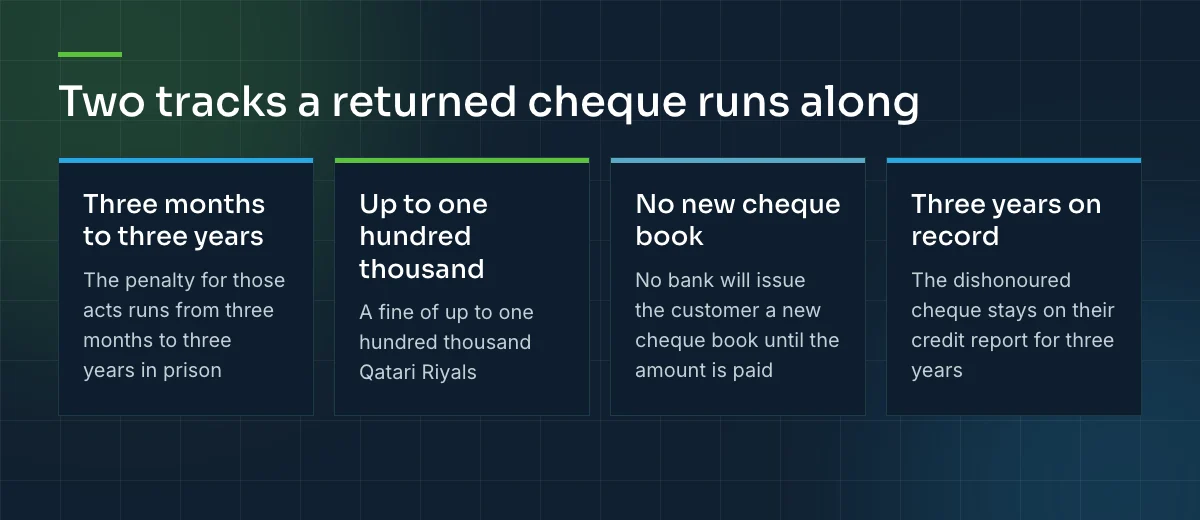
The penalty for those acts runs from three months to three years in prison, or a fine of three thousand to ten thousand Qatari Riyals, or both. Separately, issuing a cheque with nothing behind it, or with less money than its value, carries a fine of up to one hundred thousand Qatari Riyals.
The banking track, and the credit bureau record
- No bank will issue the customer a new cheque book until the amount is paid
- The dishonoured cheque stays on their credit report for three years, counted from the date it is settled
The banking track is quieter and, for a trading business, often bites harder. Every bank in Qatar has to treat the Qatar Credit Bureau as its main reference for dishonoured cheque data, so a returned cheque does not stay between you and your customer.
For a company that buys on credit and pays by cheque, losing the cheque book is close to losing the ability to trade. That is leverage, and it exists whether or not you ever file anything.
Filing a cheque bounce case in Qatar, step by step
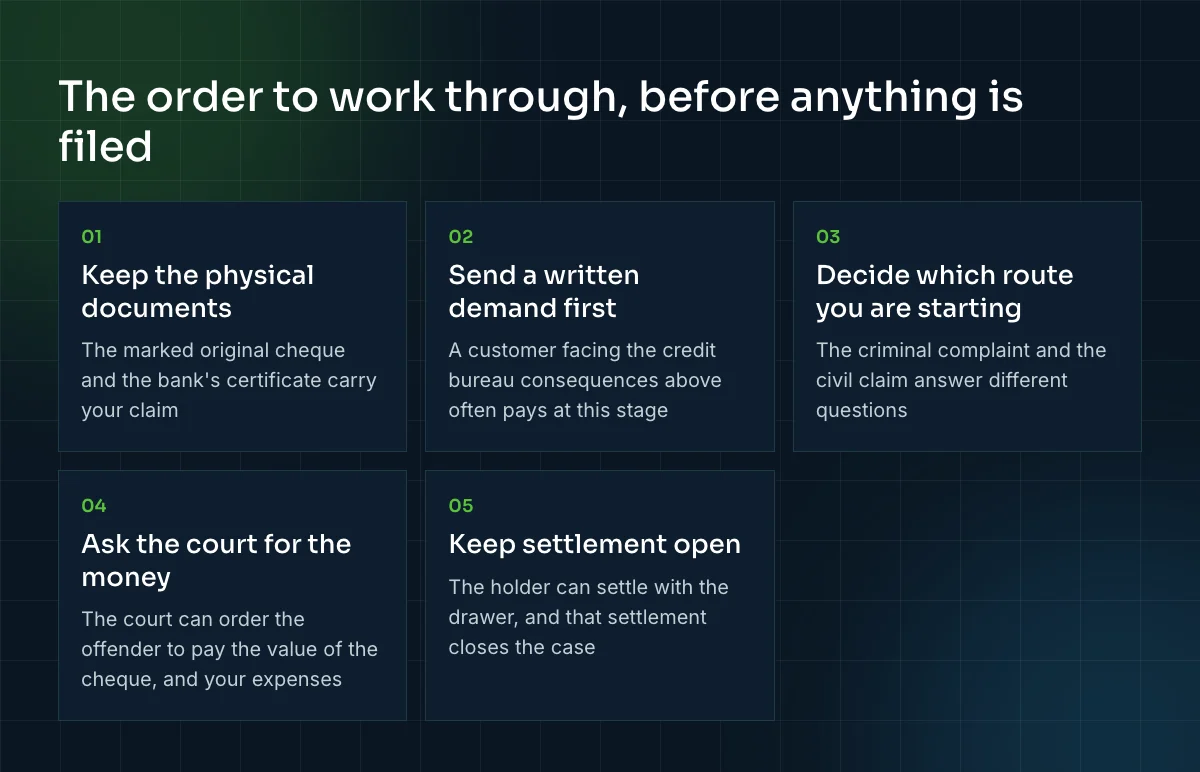
- Keep the physical documents. The marked original cheque and the bank's certificate are what carry your claim for the unpaid balance. Photocopies do not.
- Send a written demand first. A customer facing the credit bureau consequences above often pays at this stage, and a demand on the record costs you nothing if they do not.
- Decide which route you are starting. The criminal complaint and the civil claim answer different questions, and the choice is about what you want.
- Understand what the criminal court can do about the money. In an Article 357 case the court can, on the request of the party concerned, order the offender to pay the value of the cheque along with the expenses the beneficiary has incurred. You have to ask for it.
- Know that settlement is built into the process. The holder of the cheque can settle with the drawer, and that settlement closes the case, even where a sentence has already begun.
- Take advice before filing, not after. The order of these steps changes with the size of the debt, the relationship, and whether the customer has assets worth enforcing against.
A cheque bounce case in Qatar is worth starting in a deliberate order, because the early steps are the ones people get wrong.
The fourth step is the part that gets left out of most explanations of bounced cheque law in Qatar. A criminal complaint is not a bridge burned. It is a lever that can be released the moment you are paid, which is precisely why it tends to produce payment.
Mavensmark works through that order with clients as part of debt recovery. If a cheque has already been returned, book a consultation before you file anything.
The criminal route against the civil route
| Criminal route | Civil route | |
|---|---|---|
| What it turns on | Whether the drawer acted maliciously | Whether the debt is owed |
| What the court can order | The cheque's value plus your expenses, on request | The debt, with costs |
| Pressure on the drawer | Imprisonment or a fine, and a case on record | Enforcement against assets |
| Ends by agreement | Yes, settlement closes the case | Yes, by consent |
| Suits you when | The customer can pay and will not | The customer disputes the amount |
The two routes answer different questions. The criminal complaint turns on whether the drawer acted maliciously, and the civil claim turns on whether the debt is owed, so the one that suits you depends on whether your customer cannot pay or simply will not.
The step most creditors skip
- The identifying details of the business the report covers
- A summary of its dishonoured cheques
- The date, number and amount of each cheque
- The date each one was returned
- The settlement date, where there is one
The cheapest move in all of this happens before you accept the cheque at all. The Qatar Credit Bureau issues a dishonoured cheque report for companies as well as for individuals, and the fields listed above are what it carries. A customer who wants sixty days of credit and offers post-dated cheques can be checked against that record first.
Mavensmark runs that check for clients who are about to extend real credit, and the pattern it exposes is usually not a single bounced cheque qatar businesses could have absorbed. The pattern is a run of them.
Chasing a returned cheque is work Mavensmark does for clients every month, and the files that close quickly are almost always the ones where somebody spotted the exposure early.
When the cheque is not the real problem
- There is no cheque, only an invoice
- The customer has genuinely run out of money
Neither of the two situations above is helped by any of this, and pretending otherwise would waste your time.
Where there is no cheque, there is no instrument and no criminal route. An unpaid invoice with nothing behind it is an ordinary civil recovery, and unpaid debt in qatar of that kind is won on the contract, the delivery record and the correspondence rather than on the Penal Code.
Where the customer is genuinely insolvent, a filed case does not create money. A company with no assets is not made solvent by a judgment, and the cost of pursuing one can exceed what comes back. The honest question at that point is whether to settle for part of the balance now or to join the queue of creditors.