

Employment contracts in Qatar: what employers must get right
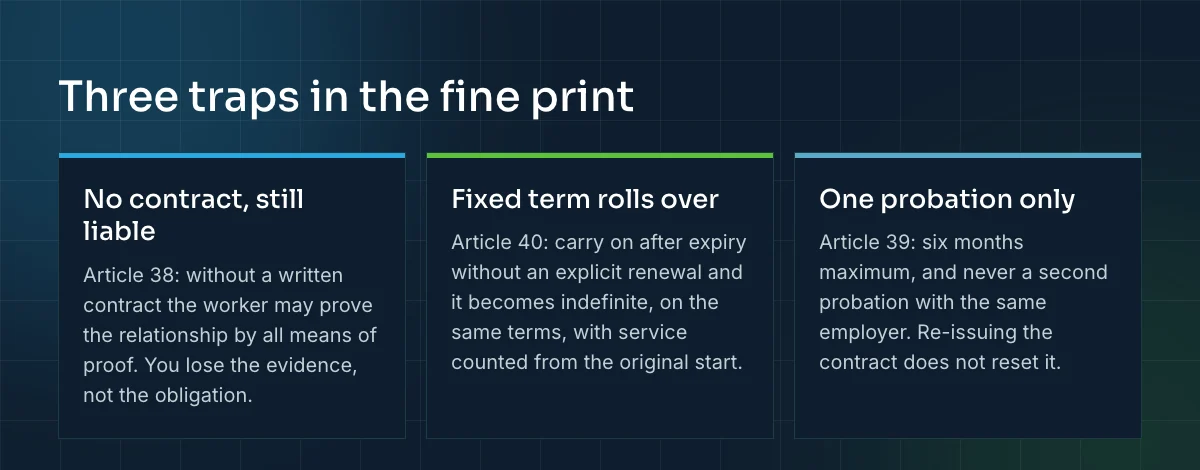
Article 38 requires the contract in writing, attested, in three copies. Without one, the worker may prove the relationship by all means of proof: you lose the evidence, not the obligation.
An employment contract in Qatar is not a formality you paper over later. Article 38 of the Labour Law requires it in writing, attested by the Ministry, in three copies, and it specifies exactly what the document must contain. Get the contract right and most disputes never start. Get it wrong and you are arguing about terms you thought were settled.
The provision that should concentrate the mind is the last line of Article 38. If the contract is not made in writing, the worker may prove the employment relationship and the rights arising from it by all means of proof. No written contract does not mean no obligation. It means the obligation is decided on whatever evidence exists, and almost none of that evidence will be yours.
What Article 38 requires the contract to contain
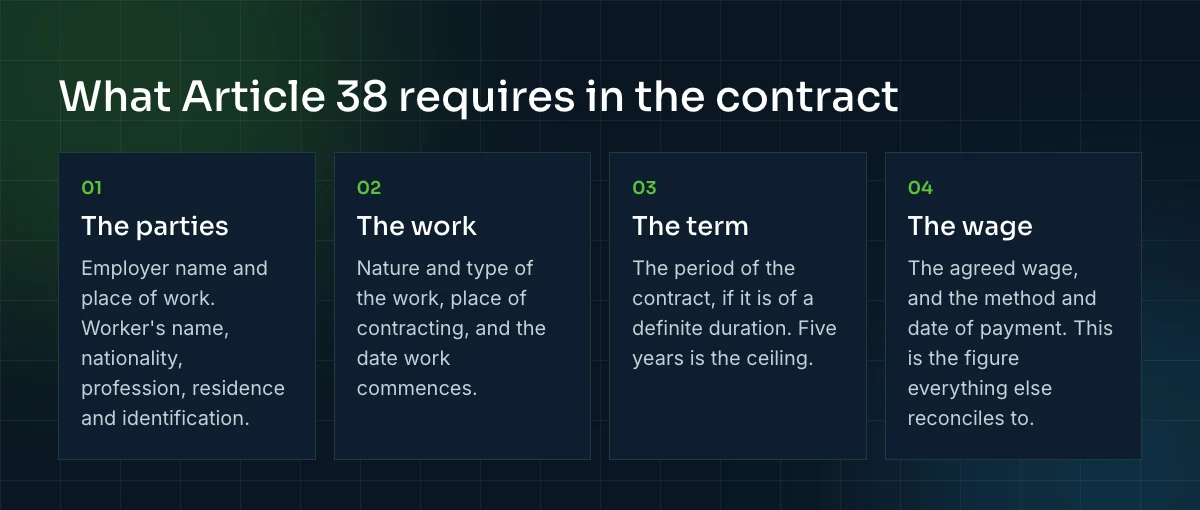
- The name of the employer and the place of his work
- The worker's name, qualifications, nationality, profession and residence, with the proof needed to identify them
- The date the contract was concluded
- The nature and type of the work, and the place of contracting
- The date work commences
- The period of the contract, if it is of a definite duration
- The agreed wage, and the method and date of payment
The wage line does more work than it looks. It is the document that fixes the basic wage, and the basic wage is the base for end of service gratuity and the figure that has to reconcile to your WPS filing every month. A contract that is vague about the split between basic and allowances creates a problem in three places at once.
Fixed term or indefinite, and the rollover trap
A limited duration contract cannot run longer than five years under Article 40, and it can be renewed for a similar period by agreement of both parties.
Here is the trap. If the contract is not renewed, and both sides simply carry on after it expires without an explicit agreement, it is treated as renewed for unlimited duration on the same conditions. A fixed term contract that nobody got round to renewing does not lapse; it converts. And because a renewal counts as an extension of the previous period, service is calculated from the original start date, not from the renewal.
That combination catches employers twice: they believe they hold a fixed term contract that has ended, when in fact they hold an indefinite one, and they calculate gratuity and notice from the wrong date.
Probation, and its limits
Article 39 allows a probation period if the two parties agree it, and caps it at six months. A worker cannot be put through more than one probation period with the same employer, so you cannot restart the clock by moving someone between roles or re-issuing a contract.
During probation the employer may terminate if it is proved that the worker is not capable of carrying out the work, on at least three days notice. Note the wording: proved, and capable of the work. Probation is not a period in which the relationship can be ended for any reason at all.
Notice, and lawful termination
| Length of service | Minimum notice |
|---|---|
| Five years or less | One month |
| More than five years | Two months |
On termination, Qatar labour law sets the notice by length of service. For a monthly paid worker on an indefinite contract, Article 49 requires at least one month where service is five years or less, and at least two months beyond that. Terminating without observing the period obliges the terminating party to compensate the other for the wage covering it.
Dismissal without notice is narrower than most employers think
Termination of an employment contract in Qatar without notice at all is possible, but only in the ten instances in Article 61, and only if the Article 62 procedure is followed: the worker informed of the accusation and inquired into in writing, action taken within fifteen days of the employer becoming aware, and one penalty for one violation. Those are the same grounds that allow gratuity to be withheld, which is why they are worth knowing before a dispute rather than during one.
The contract is a compliance document, not just an agreement
A labour contract in Qatar is attested by the Ministry and deposited with it, so it is the reference point for every downstream obligation. The wage in the contract is the wage the state expects to see in your monthly file. The commencement date is the date service runs from. The definite or indefinite status decides the notice you owe.
Because of that, the labour contract agreement in Qatar is where we start when a client asks us to review their HR exposure. Every employee contract in Qatar should say the same thing your payroll says. A tidy contract file makes payroll, gratuity accrual and any inspection straightforward. A file of unsigned drafts and superseded versions makes all three expensive.
What we do
We draft and review the employment contract in Qatar for clients as part of HR and manpower services, and we keep the file consistent with what payroll actually pays. If you are hiring your first people, this belongs in the company setup conversation rather than after the first offer letter goes out.