

Bookkeeping requirements in Qatar: the records a company must keep
Bookkeeping requirements in Qatar are the rules in the Commercial Law and the Income Tax Law that decide which books a company keeps, where it keeps them and how long it retains them. Two laws apply at the same time, with different clocks and different penalties.
Your auditor has asked for the general ledger, or the General Tax Authority wants the records behind last year's return. That is usually the moment a company learns whether its books would stand up to the law.
Bookkeeping requirements in Qatar are the rules in the Commercial Law and the Income Tax Law that decide which books a company keeps, where it keeps them and how long it retains them. Two laws apply at the same time, with different clocks and different penalties.
What are the bookkeeping requirements in Qatar?
Article 12 of the Income Tax Law, Law No. 24 of 2018, obliges every taxpayer active in the State to maintain its books of account and supporting records under Qatari law and international accounting standards, and to retain them. The Commercial Law, Law No. 27 of 2006, adds its own duty for merchants.
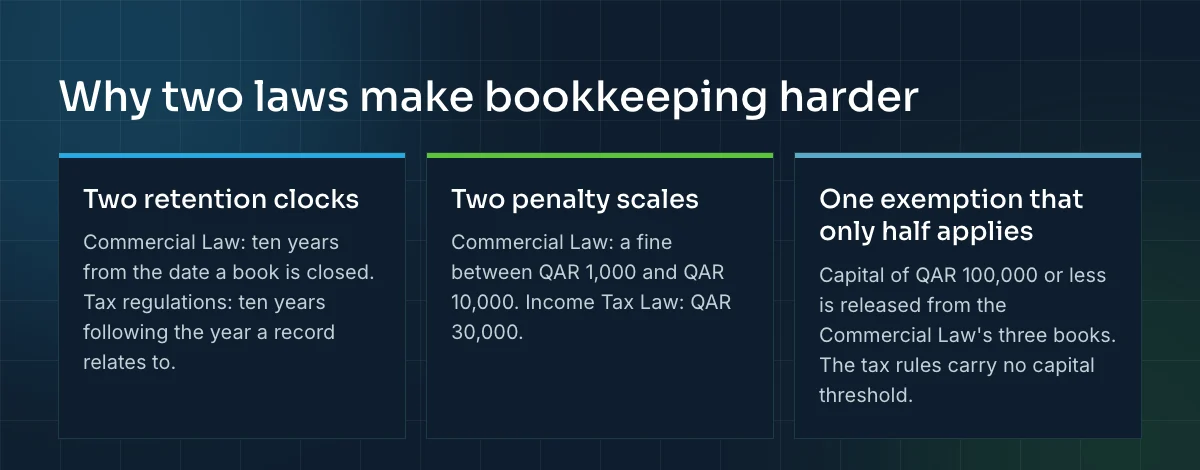
Why two laws make bookkeeping harder
- Two retention clocks. The Commercial Law runs ten years from the date a book is closed, while the tax regulations run ten years following the year a record relates to.
- Two penalty scales. The Commercial Law sets a fine between QAR 1,000 and QAR 10,000, and the Income Tax Law sets QAR 30,000.
- One exemption that only half applies. The Commercial Law releases merchants with capital of QAR 100,000 or less from its three books, but the tax rules carry no capital threshold.
Read together, the two laws do not line up neatly on these three points.
None of the articles we read sets a language for the books themselves. Confirm the position for your company before you choose a system.
What compliant books look like in practice
Most companies we meet are not ignoring their books. They are keeping them in pieces.
Sales invoices sit in one person's email. Supplier bills sit in a drawer or a shared folder. The bank statement stands in for a ledger, and the accounting software holds whatever someone found time to enter. Stock is counted when a customer complains, not when the year closes.
Each piece makes sense on the day it happens. The trouble shows when someone needs the whole picture at once: the auditor at year end, a buyer doing due diligence, or the General Tax Authority asking for the papers behind a figure on your return.
At that point the gaps are expensive to close. Invoices from three years ago are hard to trace, the person who kept them may have left, and a ledger rebuilt from bank statements shows payments without the documents that explain them. The same gaps weaken a claim for an unpaid invoice, because debt recovery in Qatar starts from the invoice, the delivery note and the messages behind the sale.
If that sounds like your finance function, the fix is not more effort at year end. It is a set of records kept the way the law describes, every month.
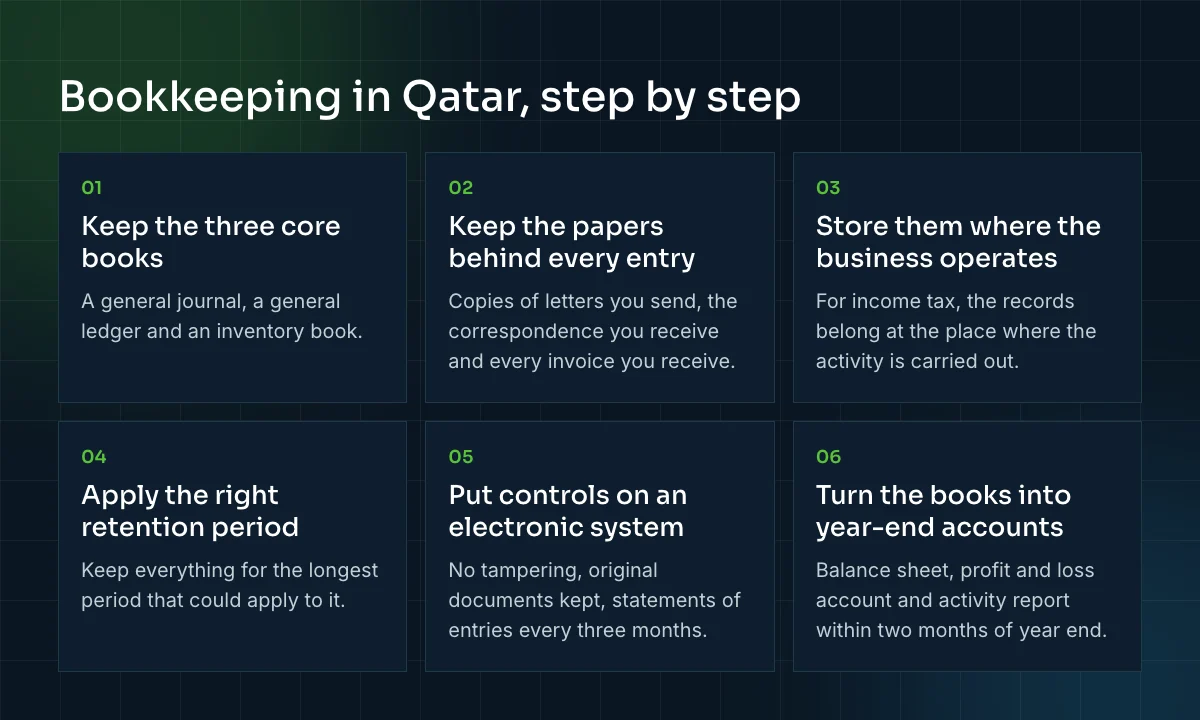
Bookkeeping requirements Qatar, step by step
- Keep the three core books. Both laws name the same three books: a general journal (the Commercial Law calls it the original daily journal), a general ledger and an inventory book. The Commercial Law adds that the books must suit the nature and size of the business and show its financial position accurately.
- Keep the papers behind every entry. The Executive Regulations, Council of Ministers Decision No. 39 of 2019, require the documents and supporting papers that sit behind the books. Under the Commercial Law, that means true copies of the business letters and messages you send, the correspondence you receive about the business, every invoice you receive and other documents connected to your trade.
- Store them where the business operates. For income tax, the records belong at the place where the activity is carried out. A box in a founder's home abroad does not meet that rule.
- Apply the right retention period to each record. Bookkeeping requirements Qatar retention depends on the law and the record, as the table below sets out.
- Put controls on an electronic system. Software is allowed, on conditions. These conditions are the internal controls the regulations expect, and they are listed below the table.
- Turn the books into year-end accounts. In a limited liability company, the managers prepare the balance sheet, the profit and loss account and a report on activity and financial position within two months of the financial year end. The general assembly appoints one or more auditors every year. Those accounts then feed your corporate tax return on Dhareeba.
| Law and record | How long to keep it |
|---|---|
| Commercial Law, core books | Ten years from the date each book is closed |
| Commercial Law, correspondence and invoices | Five years |
| Income tax, all books, records and documents | Ten years following the year they relate to |
| Income tax, records under dispute | For as long as the dispute lasts |
| After dissolution | The last managers are liable if records are not kept for five years |
On retention, the simplest policy is to keep everything for the longest period that could apply to it.
The step people skip
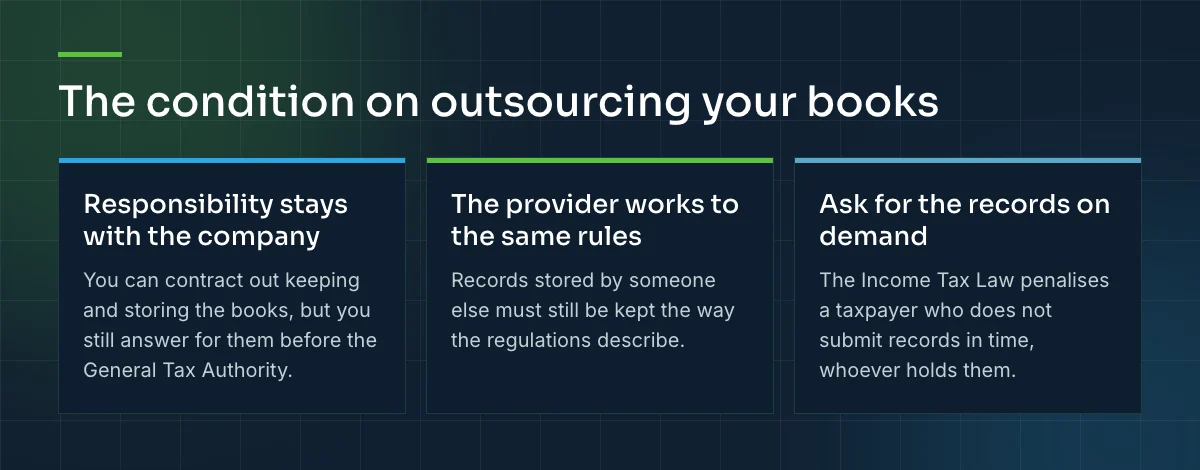
- Responsibility stays with the company. The Executive Regulations let a taxpayer contract out the keeping and storing of its books, but the taxpayer still answers for them before the General Tax Authority.
- The provider works to the same rules. Records stored by someone else must still be kept the way the regulations describe.
- Ask for the records on demand. The Income Tax Law penalises a taxpayer who does not submit records to the Authority within the period set, whoever holds them.
Most owners hand bookkeeping in Qatar to an outside provider at some point, and the regulations allow it. What they skip is reading the condition attached, which comes down to the three points above.
So the question to ask a provider is not only what they charge. Ask where your records are kept, who can retrieve them, and how fast.
Mavensmark offers bookkeeping services in Qatar for companies that would rather not build that function in-house. To discuss your records, book a consultation.
When better books will not fix it
Sometimes the books are fine and the pressure is somewhere else.
If your records are complete but the deadline worry is the tax return, start with our guide to corporate tax filing on Dhareeba. The return is a separate obligation with its own deadline.
If the gaps are in staff files, salaries and contracts, that is a payroll and labour compliance question. Mavensmark covers hiring, salary processing, employment contracts and compliance with Qatar's labour law as a separate service.
And if the company is not trading yet, there are no books to fix. Mavensmark can form the company for you, whether onshore, in a free zone or at the QFC, and the records can start correctly from the first transaction.
Ten years of records and two sets of rules: the work is lighter when the books are closed every month. If you want a second pair of eyes on how your bookkeeping requirements in Qatar are met today, book a consultation.
Frequently asked questions
How long must a company in Qatar keep its accounting records?
Do the books have to be in Arabic?
Can a small company skip bookkeeping?
Can we keep our books in accounting software?
What is the penalty for not keeping proper books?
Related services
Accounting & Bookkeeping
Accurate, standards-compliant books, so you always have reliable numbers for decisions and audits.
Learn more →Tax Compliance
End-to-end tax compliance and GCC advisory that keeps you penalty-free and audit-ready.
Learn more →Internal & External Audit
Internal, external and forensic audits that surface risk, strengthen controls and build confidence.
Learn more →