

Dhareeba: how to register, file and pay corporate tax in Qatar
Dhareeba is the only way to file a tax return in Qatar. What you must register, when the return is due, and the full penalty schedule under Article 24.
Dhareeba is the General Tax Authority's online tax portal, and since 1 November 2020 it is the only way to file a tax return in Qatar. If you run a company here, Dhareeba in Qatar is not one option among several: it is the system, and every filing obligation you have now passes through it. The old Tax Administration System was closed on that date by GTA Circular 5, so registration, the tax card, the corporate tax return, withholding tax and every other submission now run through the one portal.
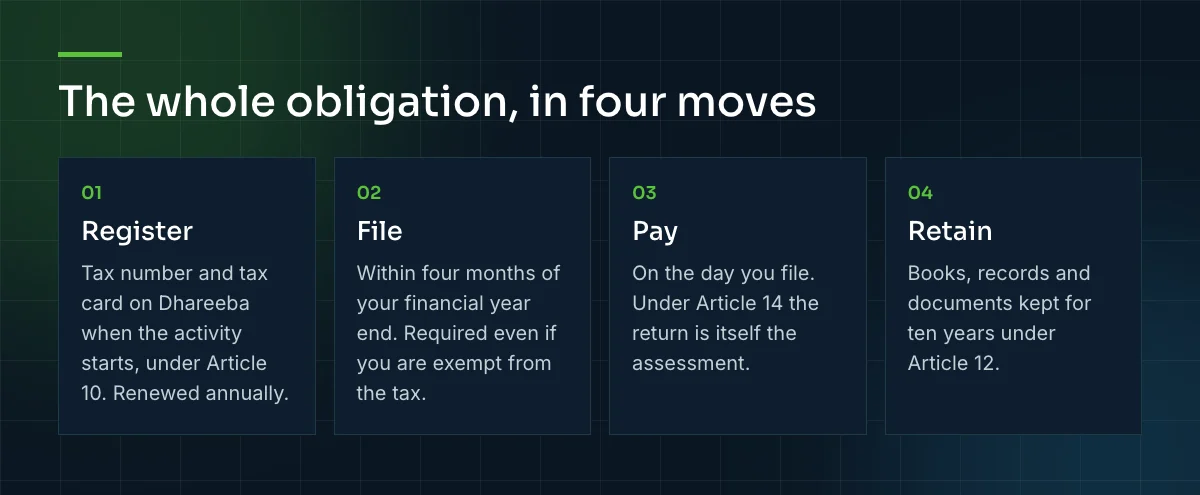
Here is the whole obligation in four sentences. Register with the Authority and obtain a tax number when you start an activity. File a return within four months of your financial year end, even if you owe nothing. Pay on the day you file, because the return is the assessment. Miss either and the penalties run automatically, per day, without anyone reviewing whether you meant to.
Who has to register and file
| Entity | Tax position | Must file a return |
|---|---|---|
| Foreign owned company | 10% on the foreign owned share of profits | Yes |
| Wholly Qatari or GCC owned | Broadly exempt from corporate income tax | Yes, and QAR 10,000 if it does not |
| Branch of a foreign company | 10% on taxable profits | Yes |
| Petroleum and petrochemical | Not less than 35%, per Law No. 3 of 2007 | Yes |
| Paying non-residents | 5% withholding under Article 9 | Yes, plus withholding returns |
Article 10 of the Income Tax Law, Law No. 24 of 2018, requires every taxpayer who carries on an activity or generates taxable income in Qatar to register with the Authority, notify it of any change affecting their tax obligations, and apply for a tax number.
The part companies get wrong is Article 11. It requires a taxpayer to submit a return even if they benefit from a tax exemption. A company wholly owned by Qatari or GCC nationals is broadly outside corporate income tax, but it is not outside the filing obligation.
Tax card registration in Qatar, and the tax number
Your first job on the Dhareeba portal is registration and the tax card. Tax card registration in Qatar establishes you as a taxpayer, produces the tax number that identifies you in every later submission, and is renewed annually. You will need your commercial registration, the trade licence, the Articles of Association, shareholder and manager identification, and your financial year end.
Get this stage right, because Article 24 attaches a QAR 20,000 penalty to breaches of the registration and notification rules. That penalty covers more than never registering. It covers failing to notify the Authority of a change that affects your tax position: a change of shareholding, activity, address, manager or financial year end. If your ownership changed last year and Dhareeba still shows the old structure, that is the provision you are sitting on the wrong side of.
Companies still at the formation stage should fold this into company setup rather than treat it as an afterthought. The tax card obligation begins with the activity, not with the first invoice.
Filing the corporate tax return
| Financial year end | Return and payment due |
|---|---|
| 31 December | 30 April |
| 31 March | 31 July |
| 30 June | 31 October |
| 30 September | 31 January |
A corporate tax return in Qatar is due within four months of the end of your accounting period.
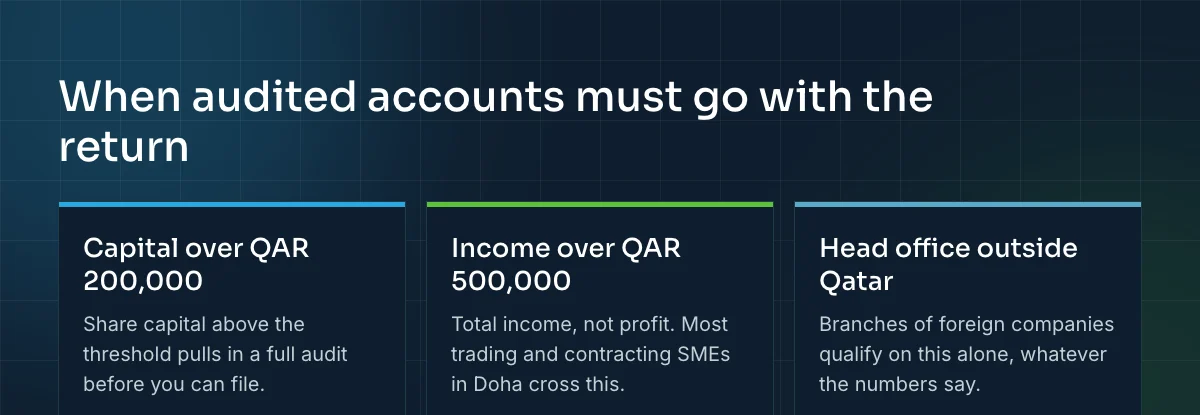
What goes with the return matters as much as the return. Audited financial statements must be attached where your capital exceeds QAR 200,000, or your total income exceeds QAR 500,000, or your head office is outside Qatar. For most trading and contracting SMEs in Doha at least one of those is true, which means Dhareeba tax filing is gated on an audit being finished first. Statements follow IFRS and, for tax years beginning on or after 1 January 2020, are submitted in Arabic. Books and records are kept for ten years under Article 12.
That sequence is the single most common cause of a late filing. The return is not the long pole; the audited accounts behind it are. A company that starts thinking about its return in month three of four has already lost.
Paying: the return is the assessment
This is the provision that surprises people. Under Article 14, tax is assessed on the taxable income shown in the return, and the return is itself the assessment and the obligation to pay, on the same day it is submitted.
There is no separate demand, no waiting for the Authority to review and come back to you with a number. Filing without paying does not buy time; it starts the late payment penalty on the amount you just declared. If cash flow is the reason a payment is going to be late, that is a conversation to have before you file, not after.
The penalties, in full
| Breach | Penalty |
|---|---|
| Late tax return | QAR 500 per day of delay, capped at QAR 180,000 |
| Late payment of tax | 2% of the tax due per month or part month, capped at the tax due |
| Registration and notification breaches | QAR 20,000 |
| Exempt taxpayer not filing the return and documents | QAR 10,000 |
| Not submitting audited accounts, or not keeping books | QAR 30,000 |
| Not notifying contracts and deals under Article 13 | QAR 10,000 |
| Not withholding tax under Article 9 | The tax not deducted, plus the tax itself |
| Breaching decisions under Article 34 | Up to QAR 500,000 |
Most guides quote the daily filing penalty and stop. Article 24 has eight limbs, and the ones that catch SMEs are usually not the famous one.
If you are already late, penalties can be waived
Article 25 is the provision worth knowing before you pay a penalty you think is unfair. The President of the Authority, or an authorised representative, may exempt a taxpayer wholly or partly from the financial penalties in Article 24 up to QAR 500,000, and the Minister may do so above that, where the taxpayer submits justifications the Authority accepts.
It is a real route and it is used. It is also not automatic, and it turns on how the case is presented: what happened, why, what has been corrected, and what makes a repeat unlikely.
One trap is written into the same article. The exemption is revoked if the taxpayer then files a grievance under Article 19. You choose one path or the other. Asking for relief and simultaneously disputing the assessment can cost you the relief you were granted. That is why penalty exemption applications sit inside our corporate tax service rather than being something we suggest you attempt alone.
Frequently asked questions
What is Dhareeba and is it compulsory?
Do we have to file a tax return in Qatar if our company is exempt from tax?
What is the penalty for filing a tax return late in Qatar?
We are already late. What are our options?
Related services
Tax Compliance
End-to-end tax compliance and GCC advisory that keeps you penalty-free and audit-ready.
Learn more →Accounting & Bookkeeping
Accurate, standards-compliant books, so you always have reliable numbers for decisions and audits.
Learn more →Internal & External Audit
Internal, external and forensic audits that surface risk, strengthen controls and build confidence.
Learn more →