

Audited financial statements in Qatar: who needs them and by when
Audited financial statements in Qatar go with the tax return when capital exceeds QAR 200,000, total income exceeds QAR 500,000, or the head office is abroad. Every WLL must also appoint an auditor yearly.
Your financial year has closed and the corporate income tax return is on the calendar. Your accountant now asks whether the accounts need an audit first.
For most trading companies the answer is yes. Audited financial statements in Qatar are year-end accounts checked and reported on by an auditor registered in Qatar, filed with the tax return of any company whose capital is above QAR 200,000, whose total income is above QAR 500,000, or whose head office sits outside Qatar.
What are audited financial statements in Qatar?
- Statement of financial position
- Statement of profit or loss and other comprehensive income
- Statement of changes in equity
- Statement of cash flows
- Notes, including the significant accounting policies
Audited financial statements in Qatar are a full set of year-end statements plus a Qatar-registered auditor's report. The Executive Regulations of the Income Tax Law list the five parts above.
The taxpayer or its tax representative signs them. Whoever helped prepare the accounts cannot also be their auditor.
Why the audit catches companies out
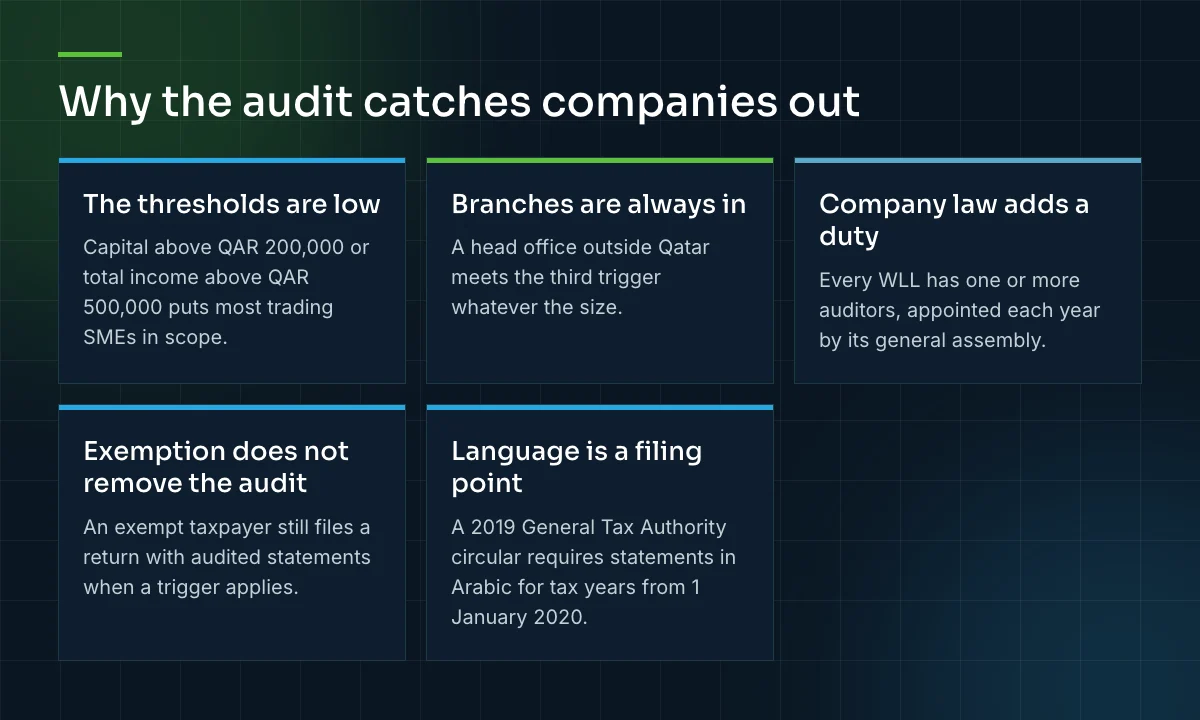
- The thresholds are low. Capital above QAR 200,000 or total income above QAR 500,000 puts most trading SMEs in scope from their first full year.
- Branches are always in. A head office outside Qatar meets the third trigger whatever the size.
- Company law adds a duty. The Commercial Companies Law gives every WLL one or more auditors, appointed each year by its general assembly.
- Exemption does not remove the audit. A taxpayer exempt under another law still files a return with audited statements when a trigger applies.
- Language is a filing point. A 2019 General Tax Authority circular requires statements in Arabic for tax years from 1 January 2020.
The rule fits in one sentence. The work sits where most owners do not look until the deadline is close.
What an audit-ready year end looks like
The year closes, the team moves on, and the books get pulled together weeks before the return is due. The auditor asks for reconciliations, records and contracts, and the gaps show up one at a time.
The timetable is tighter than most owners assume. Under the Commercial Companies Law, LLC managers have two months from year end to prepare the balance sheet, profit and loss account and activity report, then one month to send them, with the auditor's report, to the Department and each partner.
The corporate income tax return falls due four months after the tax year ends, so a 31 December year end means a 30 April filing date.
Lateness is expensive. Under the Income Tax Law, a late return costs QAR 500 a day, capped at QAR 180,000. Failing to submit audited final accounts, or to keep accounting books, carries a separate QAR 30,000 penalty.
Audited financial statements Qatar, step by step
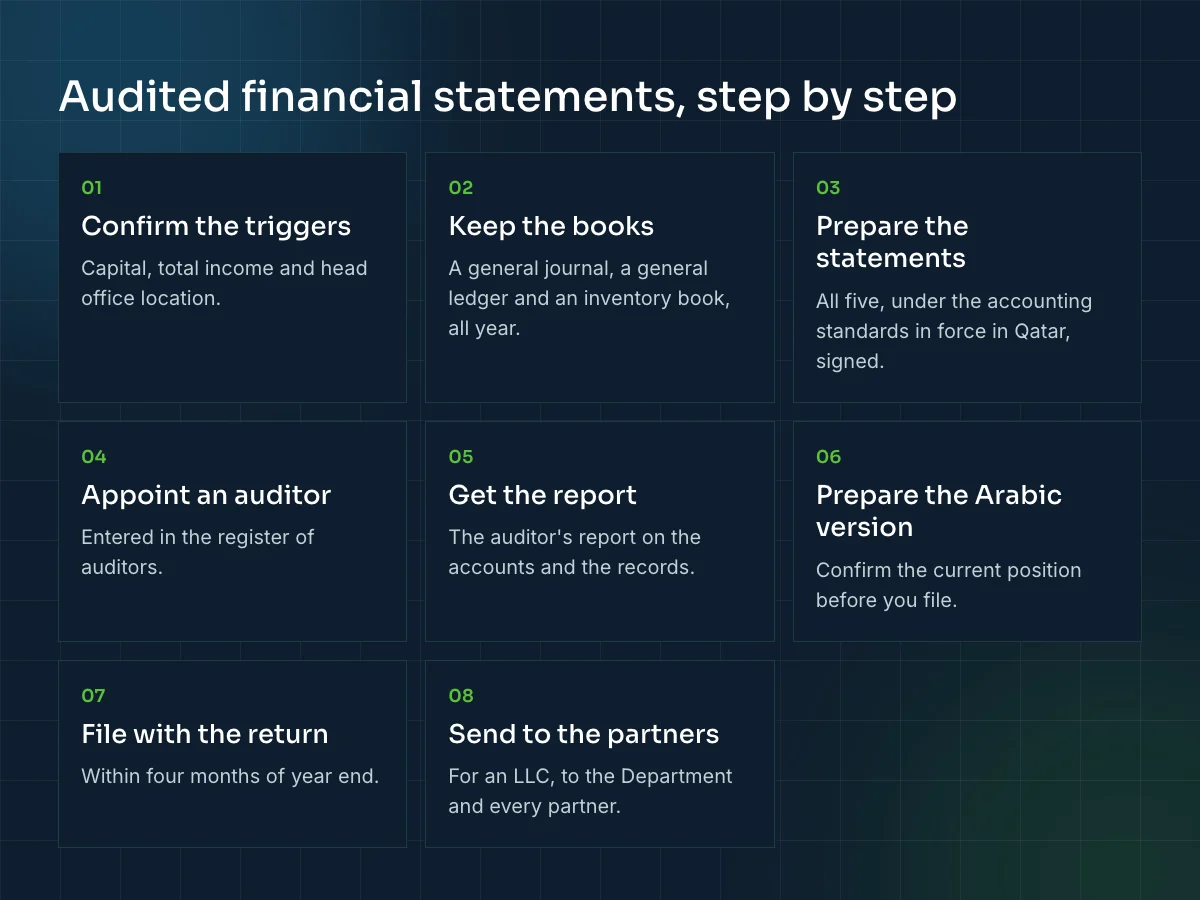
- Confirm which triggers apply. Check capital, total income and head office location. If any one trigger applies, the return needs audited statements.
- Keep the books the regulations name. Keep at least a general journal, a general ledger and an inventory book all year. Store records at the place of activity for 10 years after the year they cover.
- Prepare the statements. Prepare all five statements under the accounting standards in force in Qatar, and have them signed.
- Appoint a registered auditor. The auditor must be entered in the register of auditors. A WLL's general assembly appoints one each year, and a QFC company needs an auditor approved by the QFC Authority.
- Get the auditor's report. The report confirms the accounts follow the standards in force in Qatar, and that the company keeps proper records under internationally accepted accounting principles.
- Prepare the Arabic version. The 2019 circular applies the Arabic rule unless its regularisation period is extended, so confirm the current position before you file.
- File with the tax return. Attach the audited statements to the return within four months of year end. Our guide to corporate tax filing on Dhareeba covers the return itself.
- Send the accounts to the partners. For an LLC, send the accounts and auditor's report to the Department and every partner on the company law timetable.
If the four-month filing date in step seven is too close, the General Tax Authority can extend the deadline by up to four months. Ask, with acceptable reasons, at least 60 days before it. Silence for 30 days counts as a refusal.
Which accounting standards apply in Qatar
An audit can fail on preparation alone, so settle the basis before the year closes. The accounting standards in Qatar come from three texts, and they do not use the same words.
The Income Tax Law requires taxpayers to keep books under Qatar's laws and international accounting standards (المعايير المحاسبية الدولية in the official Arabic). Taxable income follows the accrual basis under those standards, and another method needs the General Tax Authority's approval.
Article 34 of the Executive Regulations defines the final accounts as statements prepared under "the accounting standards in force in the State", without naming a set.
How professional readings treat IFRS in Qatar
- A major advisory firm reads the tax law as requiring IFRS.
- A 2016 standard-setter profile records IFRS as required for unlisted and listed companies.
- The QFMA Offering and Listing Rulebook requires IFRS for listed companies.
Professional readings treat these rules as IFRS, as the three readings above show.
The 2016 profile cites the repealed Commercial Law No. 5 of 2002. The current Commercial Companies Law, Law No. 11 of 2015, says internationally accepted accounting principles and does not name IFRS. For IFRS compliance in Qatar, full IFRS is the reading every source shares.
IFRS for SMEs in Qatar
Qatar has not adopted the IFRS for SMEs Standard, although some Qatari companies and auditors use it as meeting the international standards requirement. We found no General Tax Authority position on it, so agree the basis with your auditor early.
Accounting standards for QFC companies
A QFC LLC prepares accounts in English under IFRS, UK GAAP, US GAAP or other standards set by QFC Authority rules. Within 4 months of year end they must be approved, audited and laid before the members, then filed with the Companies Registration Office within 21 days of that meeting.
The step people skip
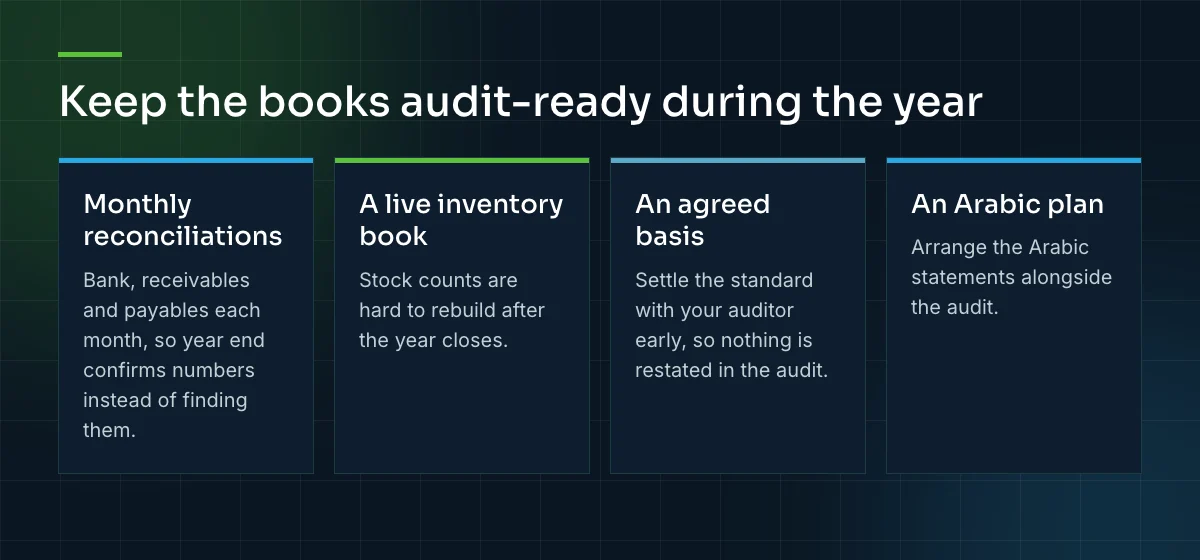
- Monthly reconciliations. Reconcile bank, receivables and payables each month, so year end confirms numbers instead of finding them.
- A live inventory book. Stock counts are hard to rebuild after the year closes.
- An agreed basis. Settle the standard with your auditor early, so nothing is restated in the audit.
- An Arabic plan. Arrange the Arabic statements alongside the audit.
The audit checks twelve months of bookkeeping. The step most companies skip is keeping the books audit-ready during the year, and the four habits above are how.
Mavensmark is a Qatar business consultancy for SMEs: accounting, tax, audit, company setup, debt recovery, HR, certifications and advisory, under one roof. Our accounting and bookkeeping service prepares books for the audit, and audit and assurance covers the statutory audit. To plan your year end, book a consultation.
When the audit is not the real problem
- Below every trigger. A company under both thresholds with a Qatar head office may not need audited statements for tax, but a WLL still appoints an auditor.
- Exempt Qatari or GCC-owned companies. The Executive Regulations apply the same triggers, but some advisers cite different thresholds from a later GTA circular. Confirm for your case.
- Groups. Whether you need consolidated financial statements depends on your structure. Ask your auditor at planning.
- No usable books. If the year was never recorded, rebuild the books first.
If your company is near a threshold or a filing date, book a consultation with Mavensmark.
Frequently asked questions
Does every company in Qatar need audited financial statements?
When are audited financial statements due in Qatar?
Who can audit financial statements in Qatar?
What is the penalty for not filing audited accounts in Qatar?
Sources
- Executive Regulations of the Income Tax Law, Article 33, Al Meezan
- Executive Regulations of the Income Tax Law, exempt taxpayers, Al Meezan
- Executive Regulations of the Income Tax Law, return deadline, Al Meezan
- Executive Regulations of the Income Tax Law, deadline extension, Al Meezan
- Executive Regulations of the Income Tax Law, Article 34, Al Meezan
- Executive Regulations of the Income Tax Law, accounting books, Al Meezan
- Executive Regulations of the Income Tax Law, record retention, Al Meezan
- Income Tax Law, Law No. 24 of 2018, penalties, Al Meezan
- Income Tax Law, Law No. 24 of 2018, accounting books, Al Meezan
- Income Tax Law, Law No. 24 of 2018, accrual basis, Al Meezan
- Circular of the GTA President No. 14 of 2019, General Tax Authority
- Commercial Companies Law, Law No. 11 of 2015, LLC auditor, Al Meezan
- Commercial Companies Law, Law No. 11 of 2015, register of auditors, Al Meezan
- Commercial Companies Law, Law No. 11 of 2015, LLC accounts, Al Meezan
- Commercial Companies Law, Law No. 11 of 2015, auditor's report, Al Meezan
- QFC Companies Regulations, Article 82, LLC accounts, QFC Regulatory Authority rulebook
- QFC Companies Regulations, Article 85, qualification of auditor, QFC Regulatory Authority rulebook
- Qatar jurisdiction profile, IFRS Foundation
- Qatar corporate tax administration, PwC Worldwide Tax Summaries
Related services
Accounting & Bookkeeping
Accurate, standards-compliant books, so you always have reliable numbers for decisions and audits.
Learn more →Internal & External Audit
Internal, external and forensic audits that surface risk, strengthen controls and build confidence.
Learn more →Tax Compliance
End-to-end tax compliance and GCC advisory that keeps you penalty-free and audit-ready.
Learn more →