

Withholding tax in Qatar: what businesses must deduct
Five percent off payments to non-residents, deducted by the payer. Miss it and Article 24 charges you the tax you did not deduct plus a penalty of the same amount, after the supplier has already been paid in full.
If your company pays a non-resident for services, royalties, interest or commissions, you are probably required to deduct five percent and remit it to the General Tax Authority. That is withholding tax in Qatar, and the obligation sits with the payer, not the recipient.
Withholding tax in Qatar is the compliance duty most often missed by otherwise careful companies, because it does not arrive as a bill. Nobody sends you an assessment. It simply attaches to a payment you were going to make anyway, and the penalty for not deducting is not the tax: it is the tax plus a penalty of the same amount.
What Article 9 actually says
- The payment is a royalty, interest, a commission, or a fee for services
- The services were performed wholly or partially inside Qatar
- The recipient is a non-resident
- The activity is not connected to a permanent establishment in Qatar
Article 9(2) of the Income Tax Law, Law No. 24 of 2018, subjects royalties, interest, commissions, and fees for services performed wholly or partially in the State, paid to non-residents for activities not related to a permanent establishment in the State, to a final withholding tax of five percent of the total amount, subject to the provisions of tax agreements and as determined by the Regulations.
Unpack that and there are four tests, all of which must hold before you deduct.
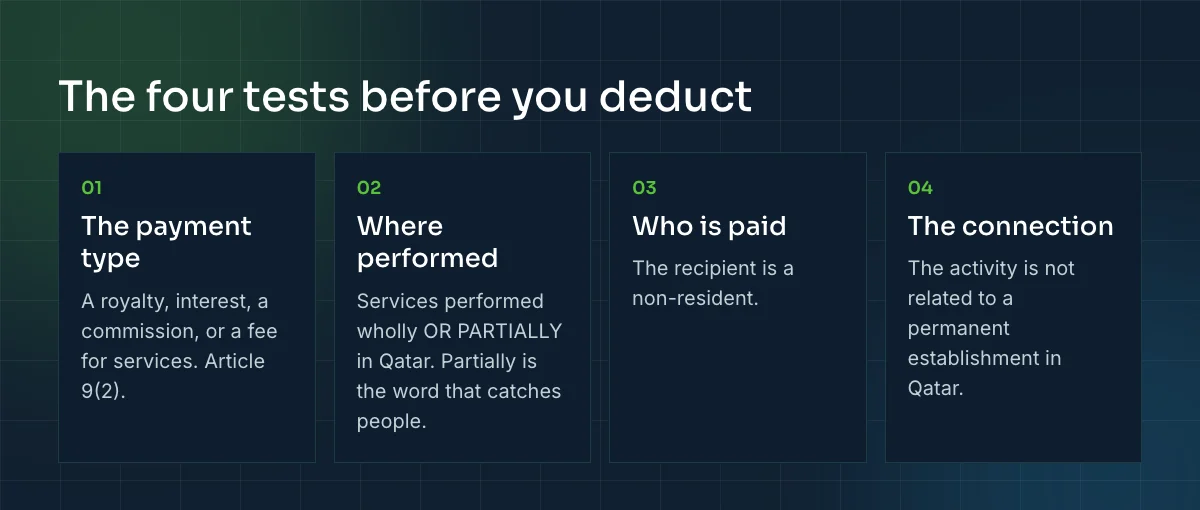
Two words that do most of the work
"Partially" means a consultant who does most of the work abroad but some of it here is still in scope. And "total amount" means the five percent comes off the gross, not off some net figure after costs.
It is a final tax, and it is subject to treaties
Finance teams usually call it WHT. The WHT tax treatment here is final, which means the deduction settles the non-resident's Qatari liability on that income; they do not then file a return for it.
The phrase "subject to the provisions of tax agreements" matters commercially. Qatar has a wide double taxation treaty network, and a treaty can reduce or remove the charge for a resident of the other state. That relief is not automatic. It depends on the recipient's residence being established to the Authority's satisfaction, so it is a documentation exercise you start before paying, not an argument you make afterwards.
The penalty is the part people underestimate
| Withheld correctly | Missed | |
|---|---|---|
| Paid to the supplier | QAR 190,000 | QAR 200,000 |
| Remitted to the Authority | QAR 10,000 | QAR 10,000, still owed |
| Article 24 penalty | None | QAR 10,000 |
| Total cost to you | QAR 200,000 | QAR 220,000 |
Article 24 lists the financial penalties, and the withholding limb is unlike the others. Failing to withhold under Article 9 carries a penalty equal to the tax that was not deducted, plus the tax itself.
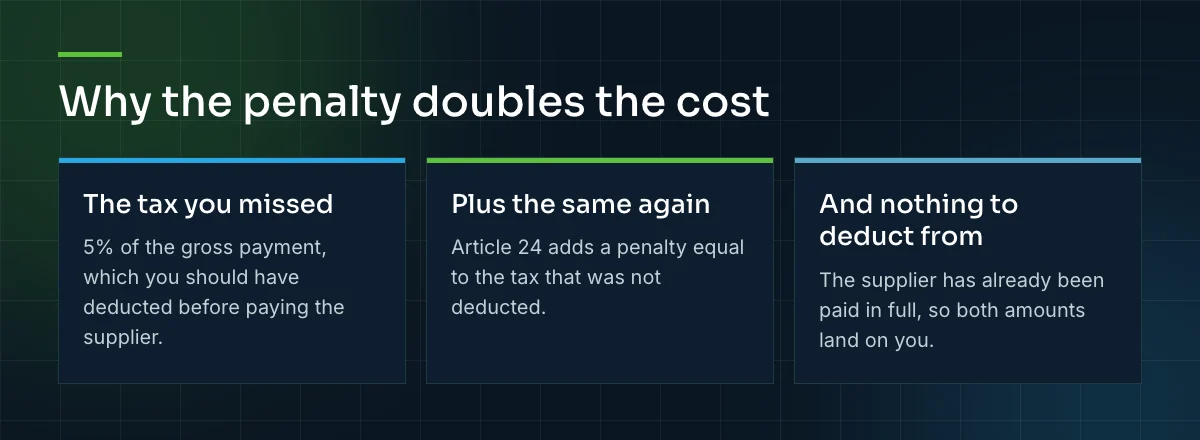
Why the check belongs in payables, not the year end review
| Typical payment | Why it is in scope |
|---|---|
| Management or licence fees to a foreign parent or affiliate | Royalties and service fees paid to a non-resident |
| An overseas software or IT provider | A fee for services, and often a royalty element too |
| A regional consultant delivering part of an engagement on site | Services performed partially in Qatar |
| Commission to an introducer based abroad | A commission paid to a non-resident |
That asymmetry is why the check belongs in your payables process rather than in the year end review. By the time the return is being prepared, the money has gone.
The recurring pattern is a company that has a clean corporate tax file and no withholding discipline at all. The triggers rarely look like tax events to whoever approves the invoice.
When it is paid, and where it is reported
The mechanics sit in the Executive Regulations. In practice the deduction is remitted to the Authority in the month following the payment, by the sixteenth, and it is reported through Dhareeba alongside your other filings.
What we do
We build the withholding check into the payables process, identify which supplier relationships are in scope, handle the treaty documentation where relief is available, and file the monthly submissions. It sits inside our corporate tax service, and because the same team keeps the books, the payments that trigger it are visible when they happen rather than at year end.