

How to start a business in Qatar as a foreigner
Since Law No. 1 of 2019 a foreign investor can own up to 100% in most sectors. The jurisdiction decision, the registration sequence, and what starts the day the CR issues.
The short answer is that it is far more open than its reputation. Since Law No. 1 of 2019 on the investment of non-Qatari capital, a foreign investor can own up to 100% of a company in most sectors, with Ministry of Commerce and Industry approval. The old assumption that you must hand 51% to a Qatari partner is out of date, and it is still the single most common thing we have to correct in a first meeting.
What follows is how to start a business in Qatar as a foreigner in the order the work actually happens. The paperwork is not the hard part. The decision that determines your tax, your ownership and whether you can sell to customers here at all is the one you make before any form is filed: which jurisdiction you set up in.
Foreign ownership under Law No. 1 of 2019
Law No. 1 of 2019 replaced the old foreign investment regime and opened most of the economy to full foreign ownership, subject to approval of your activity and structure.
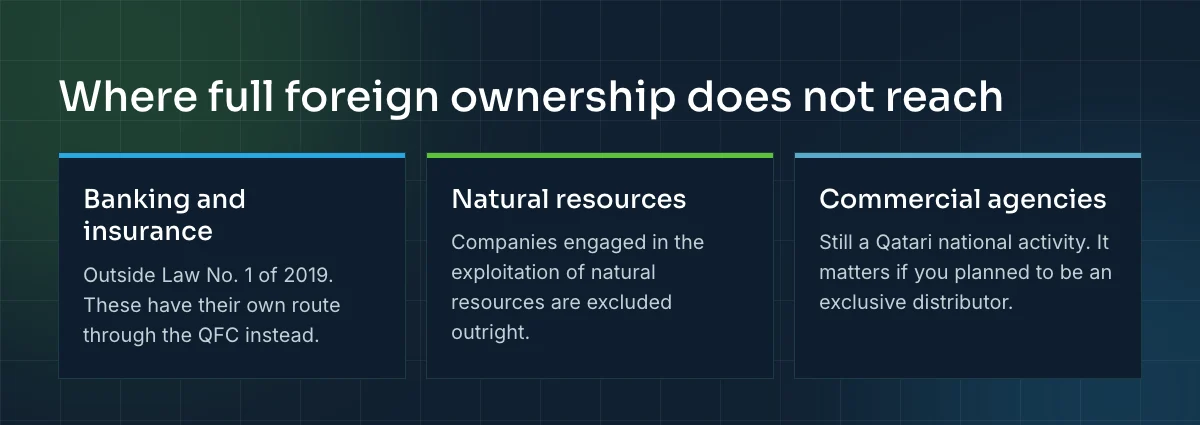
The exclusions are specific and worth knowing before you plan around them. Invest Qatar states that the 100% foreign ownership law does not apply to banking and insurance, to companies engaged in the exploitation of natural resources, to commercial agencies, or to any other sector the Council of Ministers decides. Banking and insurance have their own route through the Qatar Financial Centre. Commercial agencies remain a Qatari-national activity by design, which matters if your plan was to be the exclusive distributor for a foreign brand.
Outside those, full ownership is available on approval rather than automatic. Approval turns on the activity you apply for, so the activity codes on your application are not an administrative detail, they are the thing being assessed.
Mainland, free zone or QFC
| Mainland | Free zone | QFC | |
|---|---|---|---|
| Foreign ownership | Up to 100% on approval | 100% | 100% |
| Corporate tax | 10% on the foreign-owned share | 0% for 20 years | 10% of taxable profit |
| Sell inside Qatar | Yes | Customs duty applies on entry | Yes, it is onshore |
| Legal framework | Qatari civil code | Qatari civil code | English common law |
| Suits | Most businesses selling locally | Regional and international trade in goods | Professional services, holding, finance |
This is the decision that comes first, and getting it wrong is expensive to unwind because it means dissolving one entity and incorporating another.
Each jurisdiction is a different legal and tax regime, not a different address. The question that settles it is almost always the same: where are your customers, and are you moving physical goods?
The registration sequence on the Single Window
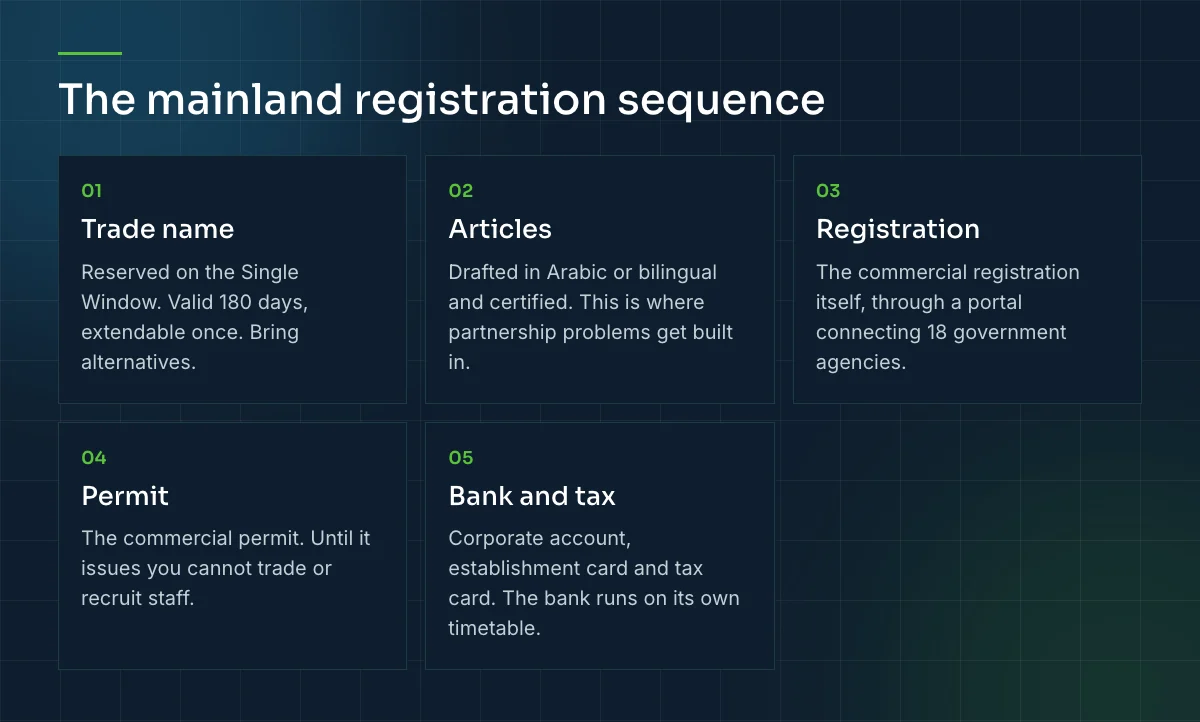
Mainland registration runs through the Single Window portal, which connects 18 government agencies so you are not walking applications between ministries. Mechanically, how to start a company in Qatar is the same sequence whoever owns it. What foreign ownership adds is an approval layer on top, not a different process.
There are two routes, and the choice matters more than it looks. Company registration is for an investor who has not yet secured premises: you can reserve a trade name and register the company, but you cannot commence operations or recruit staff until a commercial licence is issued. Comprehensive establishment covers the trade name, the commercial registration and the commercial permit together, and leaves you able to hire and trade at the end of it.
If you already have premises, take the second route. Taking the first and discovering you cannot hire is a common and avoidable stall.
This is the stage people picture when they ask how to start a business in Qatar as a foreigner, and it is the most predictable part of the whole exercise. It is also the part that goes fastest when the documents are complete and stalls for weeks when they are not.
What you need before you file anything
- Passport copies and identification for every shareholder and the proposed manager
- For a corporate shareholder, attested constitutional documents and a board resolution
- A clear description of the activity, mapped to the official activity codes
- Proposed trade name, with alternatives, since names get rejected
- Premises, or a decision to register first and license later
- Capital figure appropriate to the activity
After the commercial registration: what starts immediately
Getting the CR is the beginning of your obligations, not the end of the project. Several clocks start at once, and they start from the activity rather than from your first invoice.
Your tax registration and tax card are due under Article 10 of the Income Tax Law, Law No. 24 of 2018, and everything runs through the tax portal: see our guide to filing corporate tax on Dhareeba. The standard rate is 10% on the foreign-owned share of profits, and a return is required even if you are exempt.
From your first employee, wages must be paid through the Wage Protection System within 7 days of the due date under Ministerial Decision No. 4 of 2015. Law No. 1 of 2015, amending Article 66, sets a fine of QAR 2,000 to QAR 6,000 and possible imprisonment of up to one month for non-compliance, and the Ministry can suspend new work permits until wages are paid. That is a live risk for a young company hiring its first staff, and it is why payroll and HR is worth setting up properly at the start.
Audited financial statements will be required with your tax return once your capital exceeds QAR 200,000, or your total income exceeds QAR 500,000, or your head office sits outside Qatar. For most foreign-owned companies at least one of those is true from year one, so accounting has to be right from the first transaction rather than reconstructed at year end.
Where foreigners actually get stuck
- The activity codes do not match the business. People apply for what they think they do rather than the code that permits it, then find the approval does not cover a revenue line they were counting on.
- The Articles of Association are a template. This document fixes ownership, control, transfer of shares and what happens in a dispute. It is drafted once and lived with for years, and generic wording is where partnership problems get built in.
- The trade name is rejected. Names are refused for similarity, for restricted words and for translation issues. Bring alternatives.
- The bank account is treated as an afterthought. Corporate account opening involves its own compliance review of your shareholders, your source of funds and your business plan, and it runs on the bank's timetable rather than yours.
In our experience the delays are rarely the government's. They cluster in four places.
Doing it with help, or doing it alone
Nothing here requires a consultant. Every step of business setup in Qatar is a form you can file yourself, and plenty of people do. What a firm buys you is the sequencing and the judgement: which jurisdiction fits, which activity codes to apply for, what the Articles should say for your shareholding, and what has to be in place before the first hire.
Mavensmark has handled company setup for businesses in Qatar since 2019, from an office in Al Sadd, Doha, and the same team stays on for the accounting, tax and PRO work afterwards. If you want a second opinion on the structure before you commit to one, that conversation is free and usually takes fifteen minutes.
Frequently asked questions
What is the first decision when working out how to start a business in Qatar as a foreigner?
Can a foreigner own 100% of a company in Qatar?
Do I still need a Qatari partner or a local sponsor?
What is the minimum capital to start a company in Qatar?
How long does starting a business in Qatar take?
Can I register the company before I have an office?
Related services
Company Setup & Formation
Structure and launch your company in Qatar with the right legal framework from day one.
Learn more →Free Zone Company Formation
Set up in Ras Bufontas or Umm Alhoul with full foreign ownership, a twenty year tax holiday and no customs duty on re-exports.
Learn more →QFC Company Registration
Register onshore in the Qatar Financial Centre: full foreign ownership, ten percent tax and an English common law framework.
Learn more →